In many songs, chords simply support the melody. But in “Someone Like You” by Adele, the chords are more than accompaniment—they are the emotional engine of the entire song. The reason this song feels so intimate and heartbreaking lies in how its minor harmonic color interacts with the melodic line and the lyrical narrative.
From a musical perspective, this song lives mostly around the key area of A Major, but what makes the harmony powerful is the repeated use of relative minor movement and minor chord tension within the progression. These moments of minor harmony are not random. They are placed carefully to reflect vulnerability, memory, and emotional acceptance.
The Core Progression
One of the most recognizable progressions in the song is:
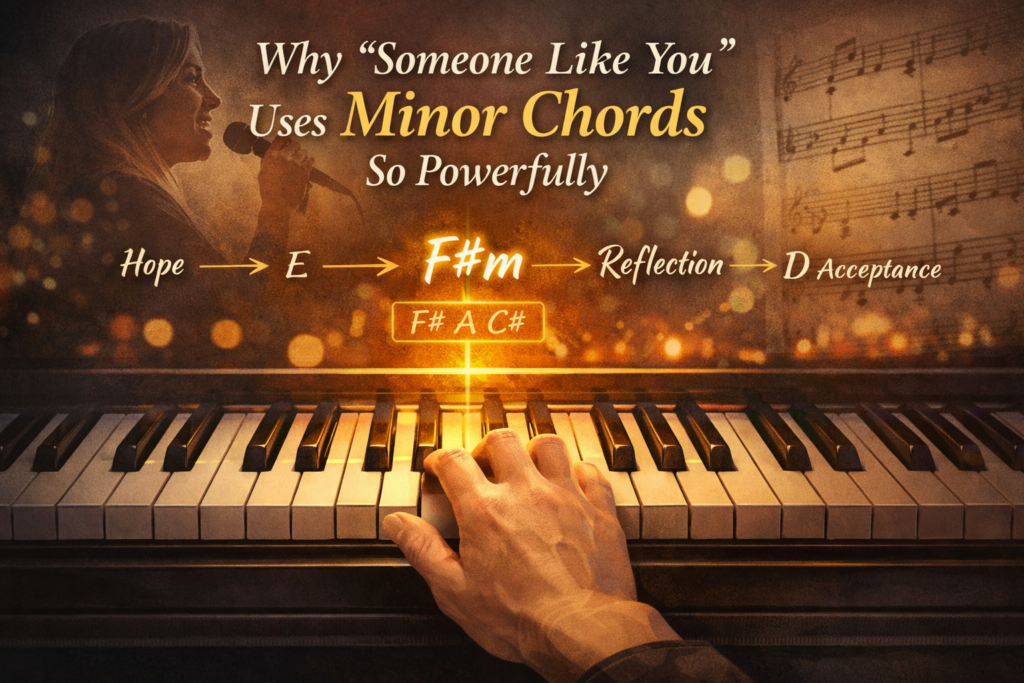
A – E – F#m – D
At first glance, this is a very common pop progression. In Roman numeral analysis within the key of A major, it becomes:
I – V – vi – IV
The crucial emotional point here is the vi chord (F# minor).
This chord is technically the relative minor of A major. Because of this relationship, it shares notes with the key but shifts the emotional color dramatically. When the progression moves from E major to F# minor, the harmony suddenly leans inward—creating a subtle but powerful feeling of reflection.
This is where the emotional weight begins to accumulate.
Why the Minor Chord Feels So Emotional
In TuneChord terms, a minor chord is not just “sad.” Its function depends on placement inside the harmonic story.
In this song, the F# minor chord acts like a moment of emotional pause. The progression begins confidently with A major and E major—two chords that feel stable and open. But once the music arrives at F# minor, the mood shifts inward.
It feels like the music suddenly remembers something.
This is the musical equivalent of the lyrical moment when the singer acknowledges the past. The harmony mirrors the emotional state: acceptance mixed with lingering pain.
Because the minor chord is placed after strong major chords, the contrast becomes stronger. If the entire progression were minor, the emotional impact would be flatter. But by placing the minor chord in the third position, the song creates a dynamic emotional curve.
The Piano Arrangement Amplifies the Minor Color
Another reason the minor harmony feels so deep in this song is the piano arrangement.
The piano does not simply block the chords. Instead, it arpeggiates them, allowing individual notes to ring and overlap. This means when the progression reaches F# minor, the notes F# – A – C# are heard clearly within the texture.
Notice that A is also the tonic note of the key. Because of this shared tone, the shift from A major to F# minor feels emotionally connected rather than abrupt.
This subtle relationship is what creates the feeling of memory instead of shock.
Minor Harmony as Emotional Narrative
If we listen carefully, the song uses its progression like a repeating emotional cycle:
Hope → Memory → Reflection → Acceptance
The major chords (A and E) carry the sense of openness and storytelling.
The minor chord (F#m) carries introspection.
The D major chord provides grounding before the cycle begins again.
This repeating loop creates a hypnotic emotional flow. Each time the progression returns, the listener feels the same emotional arc again—but slightly deeper.
This is one reason the song became globally iconic.
Why This Progression Works So Universally
The progression I–V–vi–IV is one of the most widely used harmonic patterns in modern songwriting. But in this case, the power comes from simplicity combined with emotional timing.
The minor chord appears exactly where the emotional narrative needs it.
Not too early.
Not too late.
Right after the harmonic confidence of the V chord.
That placement allows the listener to feel the shift from external storytelling to internal emotion.
The Real Lesson for Musicians
For musicians studying this song, the biggest lesson is not just the chords themselves—it is how minor harmony is positioned within a progression.
A minor chord becomes powerful when:
• It contrasts with surrounding major chords
• It appears at a reflective moment in the progression
• The arrangement allows its tones to resonate clearly
• The melody interacts emotionally with its notes
In “Someone Like You,” all of these elements align perfectly.
The result is a harmonic moment that feels incredibly human—simple on paper, yet emotionally unforgettable.
This is the real magic of songwriting: a single minor chord, placed at the right moment, can carry an entire emotional story.