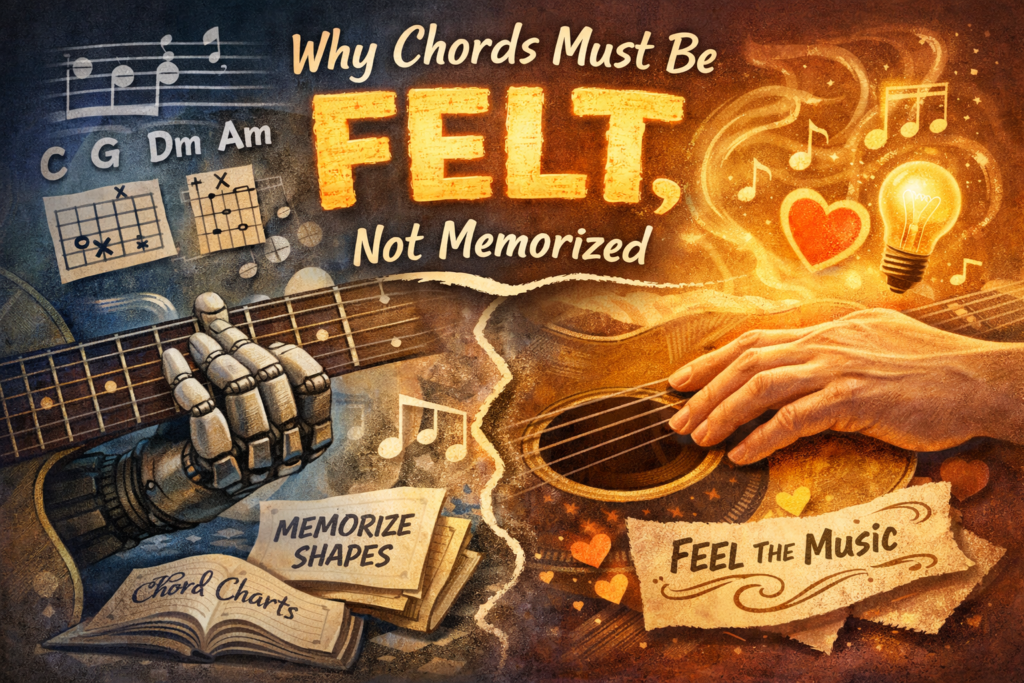
Many beginners learn chords the same way they memorize passwords: shape first, sound later. Fingers move, diagrams are followed, names are remembered—but the music often feels empty. The problem isn’t lack of practice. The problem is that chords are being treated as information, not emotion.
A chord is not just a combination of notes. It is a moment of feeling. When you play a chord, you are not pressing strings—you are releasing a mood. That mood exists whether you know the chord’s name or not.
This is why two players can play the same chord, in the same key, at the same tempo, and yet sound completely different.
One feels alive.
The other feels mechanical.
Memorizing Shapes Trains the Hand, Not the Ear
Memorization has its place. It helps your fingers find positions faster. But memorization alone creates players who know chords but don’t hear them.
When you rely only on memory:
- You change chords because the bar says so
- You stop strumming because you’re unsure
- You panic when the progression changes
Your hands move, but your ears are silent.
Music doesn’t live in the fingers. It lives in the space between sounds.
Feeling a Chord Is Listening Before Playing
To feel a chord, you must first let it speak.
Hold it.
Let it ring.
Notice what it wants to do.
Does it feel stable or unresolved?
Does it sound warm, dark, tense, or open?
Does it invite you to stay, or push you to move on?
These questions matter more than the chord name.
When your ear understands the chord, your fingers follow naturally. You stop “remembering” and start responding.
Why Feel Comes Before Speed
Many players chase speed—faster changes, more chords, more shapes. But speed without feel is noise.
Slow playing forces honesty.
When you play slowly:
- You hear bad transitions
- You feel tension and release
- You understand why a chord exists in that moment
Feeling a chord is not about emotion alone. It’s about awareness.
Chords Are Emotional Decisions
Every chord answers a question:
- Should the music rest or move?
- Should it open up or pull inward?
- Should it resolve or remain uncertain?
When you feel chords, you stop asking “What chord is next?”
You start asking “What should the music say now?”
That is the moment you stop being a chord memorizer
and start becoming a musician.
Final Thought
You can forget a chord shape and relearn it in minutes.
But once you truly feel a chord, you never forget how it sounds.
Because music is not stored in memory.
It is stored in your ear—and in your sense of feeling.
That’s why chords must be felt, not memorized.