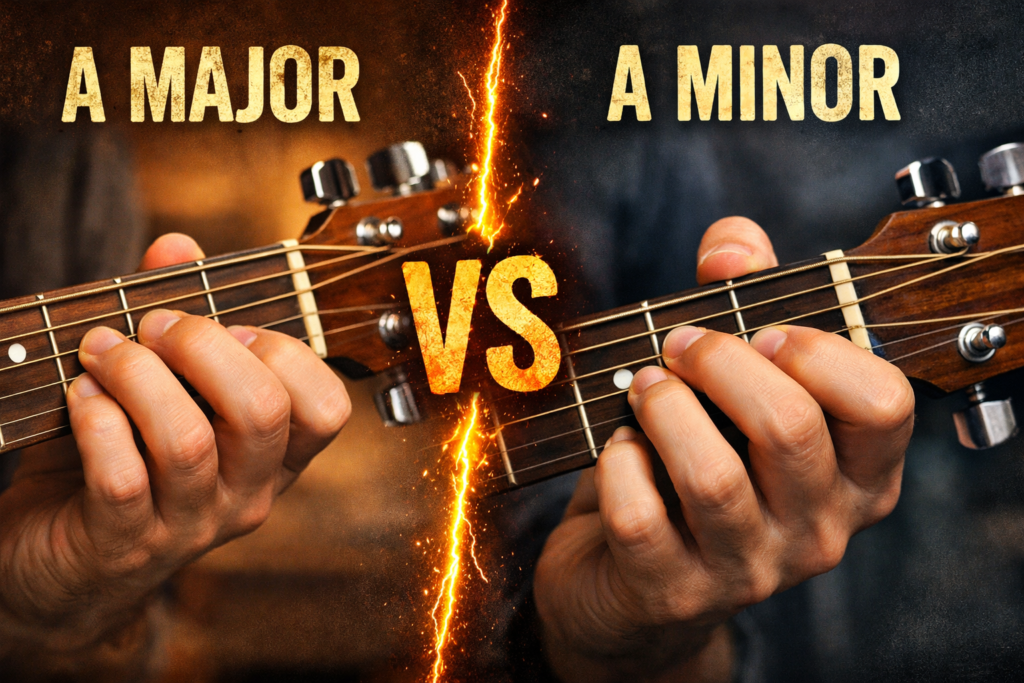
Which came first: major or minor chords?
This question often sounds simple, especially for beginners, but the answer leads us deep into the history of sound, human perception, and emotional awareness in music.
This is not only about music theory.
It is about how humans first learned to feel harmony.
Which Came First: Major or Minor Chords in Natural Sound?
Before music theory existed, sound already did.
In the natural harmonic series, tones appear in this order:
- Fundamental note
- Octave
- Perfect fifth
- Major third
The major third appears earlier and stronger in nature.
The minor third appears later, weaker, and less stable.
This means:
- Major chords sound more natural and stable
- They feel bright and complete
- They feel like “home” to the human ear
So historically and physically, major chords came first, long before anyone named them.
Which Came First: Major or Minor Chords in Early Music History?
In early Western music and the medieval period, musicians did not think in terms of major and minor keys yet. Instead, they used modes.
However, when harmony started to form:
- Major triads appeared more frequently
- Minor chords were treated as color, not as a tonal center
Major represented resolution and certainty.
Minor felt unresolved, introspective, and fragile.
Not because minor was wrong —
but because music had not yet learned to stay inside that emotion.
Which Came First: Major or Minor Chords in the Tonal Era?
Between the 17th and 19th centuries, the tonal system was established.
At this point:
- Major and minor were recognized as equal tonal systems
- Both became official foundations of Western harmony
Yet emotionally, their roles remained different:
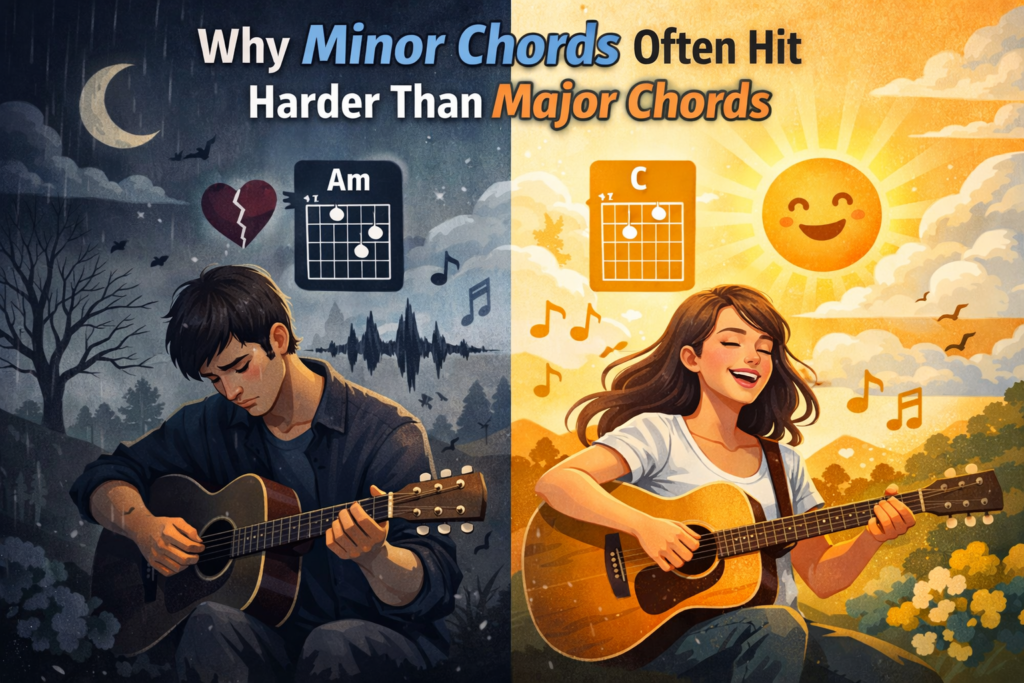
- Major → stability and clarity
- Minor → inner expression and depth
That is why:
- Children’s songs are mostly in major
- Reflective, emotional, or melancholic songs are often in minor
Minor did not replace major.
Minor expanded what music could feel.
Which Came First: Major or Minor Chords in Musical Feel?
Forget theory for a moment. Let’s talk about feeling.
- Major chords feel like: standing upright in daylight
“I am okay” - Minor chords feel like: sitting quietly at sunset
“I’m still here, even if I’m tired”
Major came first because humans needed certainty before understanding vulnerability.
Minor arrived when music became brave enough to be honest.
So, Which Came First: Major or Minor Chords?
Here is the clear answer:
✔ In sound physics → Major came first
✔ In music history → Major was standardized earlier
✔ In emotional evolution → Minor arrived as deepening
Today, they are equal.
But their emotional functions are never the same.
Final Note for Musicians
Never choose a chord just because:
- “Major equals happy”
- “Minor equals sad”
Because:
- Major progressions can feel dark
- Minor progressions can feel warm
Everything depends on context, progression, and emotional honesty.
At TuneChord, chords are not symbols.
They are stories waiting to be felt.