There was a time when music tried to impress you first.
Louder guitars.
Faster solos.
Higher notes.
Bigger stages.
For decades, especially before the 1990s, music—particularly rock—was often about display. Technical skill was celebrated. Complexity was admired. Songs were built to prove something: speed, power, virtuosity.
Then something shifted.
Quietly, without permission, music stopped asking, “Are you impressed?”
And started asking, “Do you feel this?”
The End of Musical Exhibition
By the late 80s, technical excellence had reached its peak. Guitar heroes dominated. Perfect execution was no longer rare—it was expected.
But when everything becomes impressive, nothing feels personal anymore.
Listeners didn’t stop loving music.
They stopped believing it.
Songs sounded flawless, yet distant.
Powerful, yet empty.
This was not a technical problem.
It was an emotional one.
The 90s Didn’t Change Music — They Changed Intention
The 1990s didn’t invent new chords.
They didn’t erase music theory.
They didn’t reject musicianship.
They redefined intention.
Music no longer existed to dominate a room.
It existed to occupy a feeling.
Suddenly:
- Imperfect vocals felt honest
- Simpler chord progressions felt closer
- Repetition felt meditative, not lazy
What mattered was not how much you could play—but why you played it.
When Simpler Chords Became Stronger
One of the clearest signs of this shift was harmonic choice.
Complex harmony didn’t disappear, but it stepped back.
Instead of:
- Constant chord changes
- Dense voicings
- Extended harmonic movement
Music leaned into:
- Repetition
- Open intervals
- Static harmony
Why?
Because space started to matter more than movement.
A chord held longer allowed lyrics to breathe.
A progression that didn’t rush let emotion settle.
The power moved from progression to presence.
Distortion Lost Its Ego
Even distortion changed its role.
Before, distortion screamed:
“Listen to me.”
In the 90s, distortion whispered:
“This hurts.”
It wasn’t cleaner.
It wasn’t prettier.
It was more human.
Guitars no longer led songs by force.
They supported songs by texture.
Sometimes the most powerful moment wasn’t the chorus—
but the silence before it.
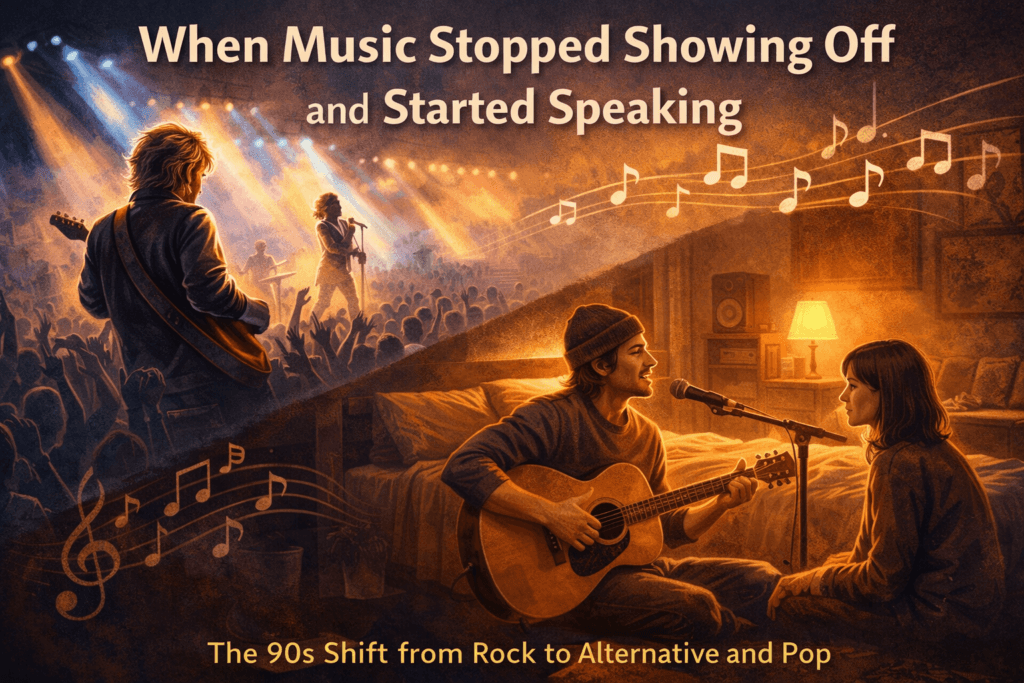
From Stadiums to Bedrooms
Another shift happened in scale.
Music left stadiums and entered bedrooms.
Not physically—but emotionally.
Songs stopped trying to unite crowds and started speaking to individuals.
Headphones replaced amplifiers.
Lyrics replaced licks.
Mood replaced mastery.
This wasn’t a downgrade.
It was intimacy.
Music stopped shouting across a room
and started sitting beside the listener.
Technique Didn’t Disappear — It Changed Purpose
This is important.
The 90s were not anti-skill.
They were anti-ego.
Technique was no longer the message.
It became invisible support.
Great players still existed—but they served:
- the song
- the mood
- the moment
The best technique was the one you didn’t notice.
Why This Shift Still Matters Today
Modern musicians still struggle with this question:
“Should I play better, or feel more?”
The answer isn’t either/or.
The lesson from the 90s is balance.
Technique gives you options.
Feel gives you direction.
Without feel, technique becomes noise.
Without technique, feel becomes frustration.
Music speaks best when both agree.
TuneChord Perspective: Chords as Language
At TuneChord, we don’t see chords as shapes.
We see them as sentences.
In the 90s, music changed its vocabulary:
- Fewer words
- Clearer meaning
- Longer pauses
A chord stopped being a tool for movement
and became a container for emotion.
That is why so many 90s songs still feel relevant.
They didn’t chase trends.
They expressed states of being.
Final Reflection
When music stopped showing off, it didn’t become weaker.
It became braver.
It chose honesty over perfection.
Connection over complexity.
Meaning over mastery.
And in doing so, it reminded us:
Music doesn’t need to impress you.
It needs to speak to you.