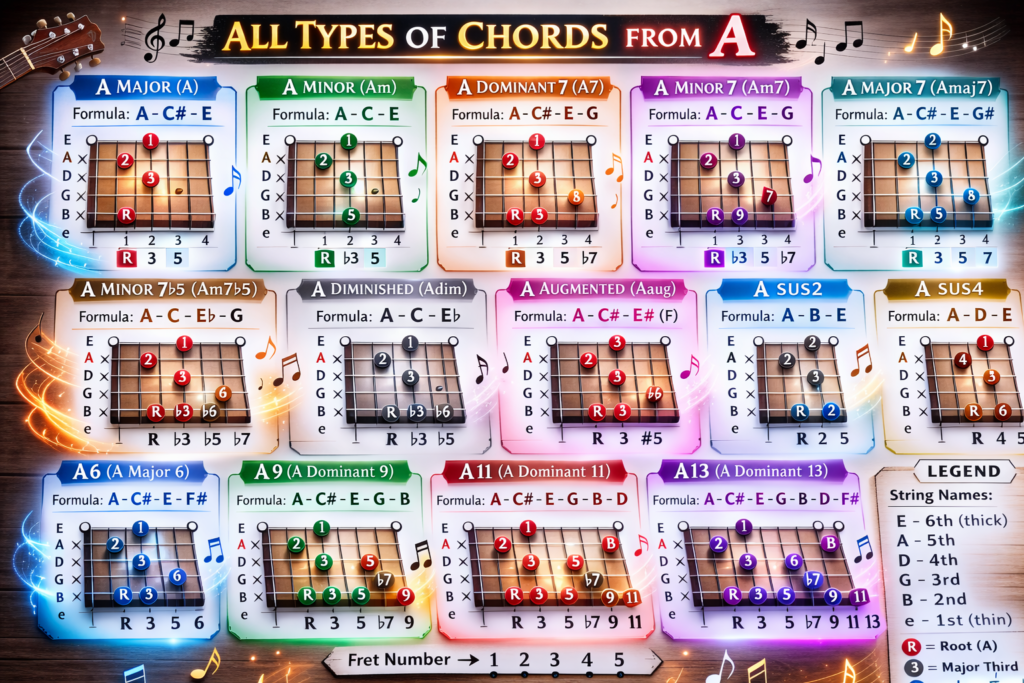
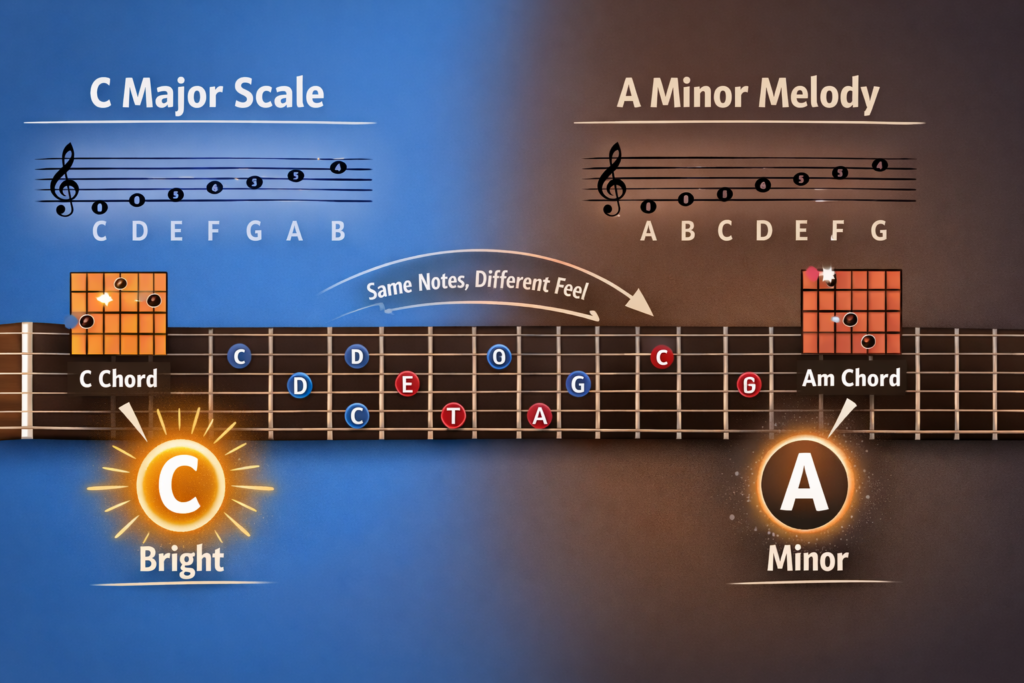
In music theory, one of the most fascinating relationships is the connection between the C major scale and the A minor scale. At first glance they appear to belong to different emotional worlds. One sounds bright and stable, while the other often feels reflective or melancholic. Yet technically, they share exactly the same notes.
Understanding this relationship opens an important door for musicians, especially when writing melodies, improvising solos, or understanding why certain chord progressions feel naturally connected.
One Scale, Two Emotional Centers
The C major scale consists of these notes:
C – D – E – F – G – A – B – C
The A natural minor scale consists of:
A – B – C – D – E – F – G – A
Notice something surprising: the notes are identical. There are no sharps and no flats in either scale. This means both scales live inside the same tonal environment.
In music theory, this relationship is called a relative major and minor pair.
The key difference is not the notes themselves. The difference is where the music feels resolved.
In C major, the tonal gravity points toward C. Melodies often land on C, and chord progressions feel complete when they resolve to the C major chord.
In A minor, however, the tonal gravity shifts toward A. Even though the notes remain the same, the emotional center moves.
This simple shift completely changes the musical feeling.
Why A Minor Melodies Fit Over C Major Harmony
This is the reason why musicians can play A minor melodies over chord progressions built from the C major scale and everything still sounds natural.
Consider this chord progression:
Am – F – C – G
These chords all belong to the harmonic family of the C major scale. Yet when the progression begins or emotionally resolves to Am, the listener perceives the music as being in A minor.
Now imagine improvising a melody using these notes:
A – C – D – E – G – A
All of these notes come from the C major scale. However, if the melody frequently lands on A, the ear interprets A as the home note. The result feels unmistakably minor.
The scale did not change. Only the center of gravity did.
The Hidden System Behind Many Songs
Many popular songs rely on this relationship. Songwriters often compose chord progressions within the C major harmonic system, while allowing melodies to emphasize A minor emotion.
This creates a powerful balance. The harmony remains simple and familiar, but the emotional color becomes deeper.
For guitar players, this realization is particularly useful.
If you already know how to play the C major scale on the fretboard, you already possess the notes of the A minor scale. The difference lies only in how you use them:
- Emphasize A to create a minor mood
- Emphasize C to create a major resolution
The fretboard shape does not change. The musical story does.
TuneChord Insight: The Feeling Comes From the Landing Note
From a chord perspective, scales are not just collections of notes. They are fields of tension and release.
In the shared world of C major and A minor, every note belongs to the same landscape. But the emotional destination defines the journey.
When melodies repeatedly return to A, the music breathes like A minor.
When they resolve to C, the same notes suddenly feel bright and complete.
The scale stays the same, but the feeling shifts completely.
And this is one of the most important lessons for musicians:
Music is not only about which notes you play — it is about where the notes want to go.