Understanding Types of Chords
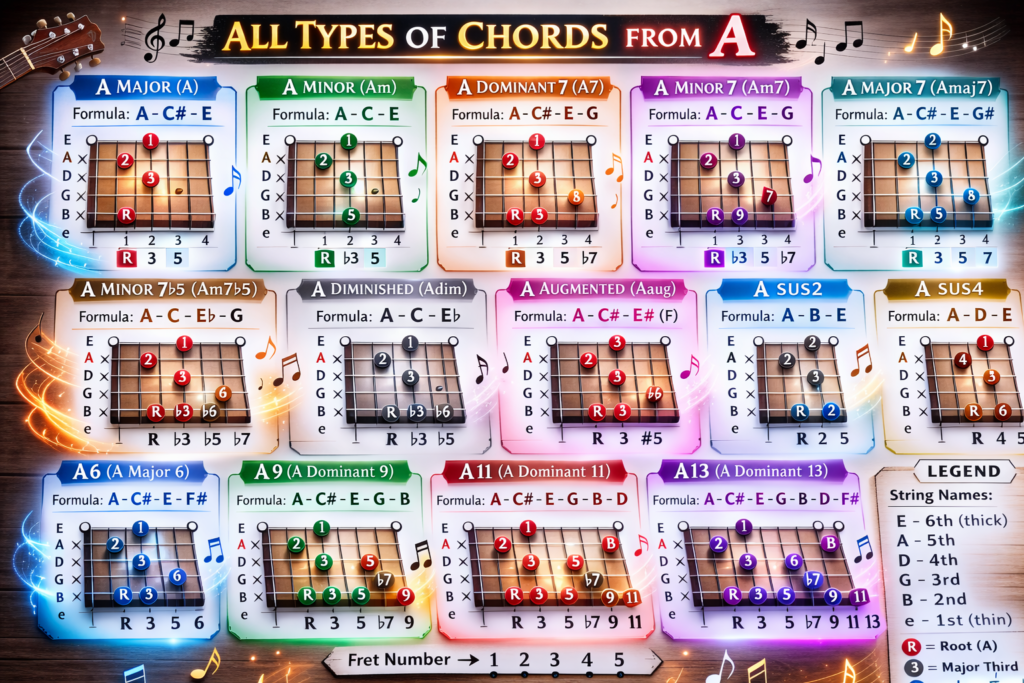
Chords are the foundation of any song. Knowing the types of chords and their characteristics helps you craft music that communicates emotion clearly. The most common chords are major, minor, diminished, and augmented, each with unique formulas and musical feel.
1. Major Chords
- Formula: Root (R) + Major Third (3) + Perfect Fifth (5)
- Nuance: Bright, happy, uplifting
- Typical Use: Pop, rock, country, folk
- Example: C major (C-E-G) evokes a joyful, open feeling, perfect for cheerful melodies.
2. Minor Chords
- Formula: Root (R) + Minor Third (b3) + Perfect Fifth (5)
- Nuance: Sad, melancholic, introspective
- Typical Use: Blues, pop ballads, jazz, R&B
- Example: A minor (A-C-E) gives a reflective or emotional tone, often used in heartfelt songs.
3. Diminished Chords
- Formula: Root (R) + Minor Third (b3) + Diminished Fifth (b5)
- Nuance: Tense, suspenseful, unstable
- Typical Use: Jazz, classical, horror soundtracks
- Example: B diminished (B-D-F) creates tension, often leading to resolution in a progression.
4. Augmented Chords
- Formula: Root (R) + Major Third (3) + Augmented Fifth (#5)
- Nuance: Dreamy, mysterious, unresolved
- Typical Use: Jazz, cinematic, progressive rock
- Example: C augmented (C-E-G#) adds color and surprise in chord progressions.
5. Extended Chords (7ths, 9ths, 11ths)
- Formula: Add extra scale degrees beyond the triad
- Nuance: Sophisticated, jazzy, emotional
- Typical Use: Jazz, soul, R&B, pop
- Example: G7 (G-B-D-F) gives a bluesy tension, preparing for the next chord resolution.
Practical Tip:
Try mixing major and minor chords in a simple progression like C – Am – F – G. Notice how the song’s feel changes depending on which chord leads to which. Chords are more than theory—they are emotional tools. Experiment with different chord types to find the vibe that suits your song.
Conclusion:
Understanding the types of chords and their emotional impact allows you to write songs that resonate. From major’s joy to minor’s melancholy, diminished tension, and augmented surprise, each chord contributes a musical color to your composition.