Among the many traditional music styles that survived centuries of cultural change, Flamenco remains one of the most emotionally powerful. Even people who have never studied music theory can immediately recognize the sound of flamenco. The moment the guitar begins to move through its characteristic chord progression, something dramatic appears in the atmosphere—something intense, passionate, and deeply human.
That emotional intensity does not come only from fast guitar techniques or expressive singing. The real secret lies deeper: the chord structure and tonal language that define flamenco music.
Flamenco was born in Andalusia, in southern Spain, a region historically shaped by cultural crossings between Europe, North Africa, and the Middle East. The music was strongly influenced by the Romani communities who lived in the region, along with Andalusian folk traditions and the legacy of Moorish culture.
From these cultural layers emerged a musical language where chords are not merely harmonic tools—they are emotional engines.
For musicians who study harmony deeply, flamenco is a fascinating example of how a unique chord system can define the identity of an entire musical culture.
Why Flamenco Chords Feel So Dramatic
To understand the emotional power of flamenco, it helps to compare it with modern popular music.
Most pop music uses chord progressions like:
- I – V – vi – IV
- I – IV – V
These progressions sound stable and familiar because they move around the tonal center in predictable ways.
Flamenco, however, often relies on a progression known as the Andalusian cadence. One common version in A minor looks like this:
Am – G – F – E
At first glance, the chords look simple. But the emotional effect is striking.
This progression creates a dramatic sensation because:
- The bass line descends step by step, creating a feeling of gravity.
- The final dominant chord (E) produces strong tension before resolving.
The result is a musical motion that feels both melancholic and explosive at the same time.
In flamenco performance, this progression becomes even more powerful when combined with rhythm, guitar articulation, and vocal expression.
The Phrygian Mode: The Hidden Color of Flamenco
Another reason flamenco sounds so unique is its frequent use of the Phrygian mode.
In Western music, most compositions rely on the major scale or natural minor scale. Flamenco often uses Phrygian tonalities that create a distinctive Eastern flavor.
For example, the E Phrygian scale looks like this:
E – F – G – A – B – C – D – E
Notice the half-step interval between E and F. This small distance creates an immediate sense of tension and mystery.
Because of this tonal color, flamenco music sometimes reminds listeners of Arabic or Middle Eastern sounds. That connection is not accidental; Andalusia historically experienced centuries of interaction with Moorish culture.
In flamenco guitar playing, chords like these often appear:
- E major
- F major
- G major
- A minor
However, they are voiced and articulated in ways that give them a completely unique character.
The Guitar: Where Flamenco Chords Come Alive
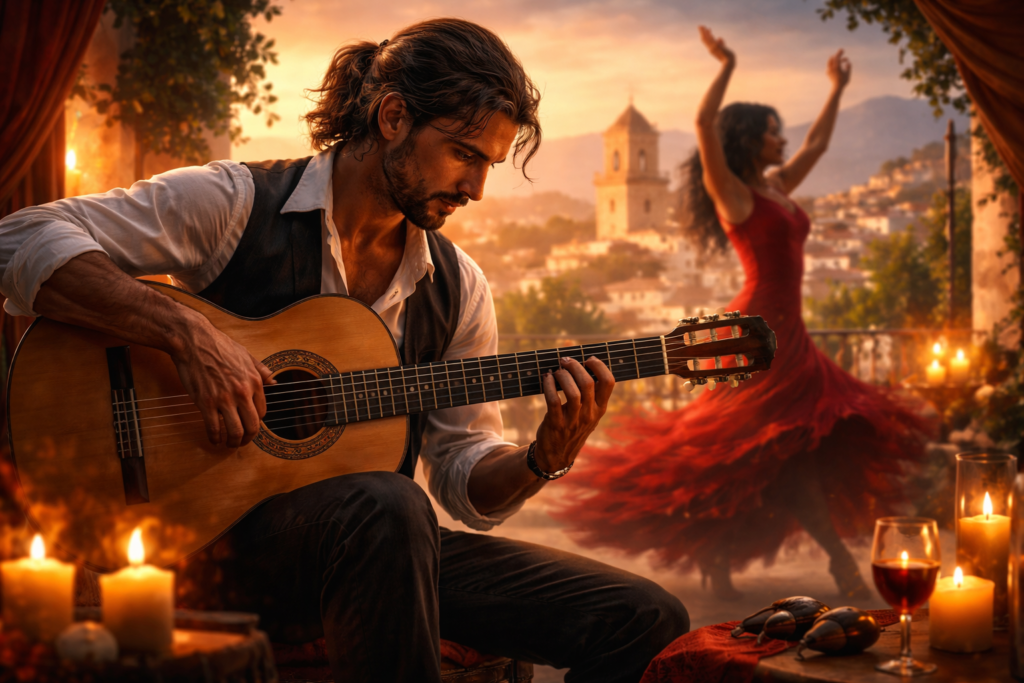
It is impossible to talk about flamenco without discussing the guitar. In flamenco music, the guitar is not simply an accompaniment instrument—it acts as rhythm section, harmony, and emotional storyteller all at once.
One of the most influential figures who shaped modern flamenco guitar is Paco de Lucía. His playing transformed the perception of flamenco worldwide, combining traditional techniques with advanced harmonic exploration.
In flamenco guitar, chords are rarely played in a static way. Instead, they are animated by techniques such as:
Rasgueado
A rapid strumming technique using multiple fingers that creates explosive rhythmic textures.
Golpe
A percussive tap on the guitar body that adds rhythmic emphasis.
Picado
Fast melodic runs played with alternating fingers.
These techniques make the chords feel alive and percussive, turning harmony into rhythm and rhythm into emotion.
Chords as Emotional Language
One of the most fascinating aspects of flamenco is the way harmony interacts with human emotion.
Traditional flamenco songs often revolve around themes such as:
- suffering
- longing
- love and heartbreak
- freedom and struggle
Because of these themes, minor tonalities and Phrygian colors naturally fit the expressive world of flamenco.
When a progression like Am – G – F – E is performed slowly, with intense vocal expression, the music can feel almost theatrical. The chords create waves of tension and release that mirror human emotional experiences.
In this sense, flamenco harmony is not just theory—it is emotional storytelling through sound.
Rhythm: The Force That Shapes Flamenco Harmony
Another essential element that strengthens flamenco chords is rhythm.
Flamenco uses complex rhythmic cycles known as compás. Many styles rely on a 12-beat pattern with specific accents that determine when chords should change.
For example, forms like Soleá or Bulerías use intricate rhythmic structures where harmony and rhythm are tightly connected.
When a chord change happens on the right rhythmic accent, the emotional impact becomes far stronger.
This interaction between rhythm and harmony gives flamenco its unmistakable dramatic character.
Why Flamenco Still Lives Today
Many traditional musical styles disappear as musical trends evolve. Flamenco, however, continues to thrive globally.
Several factors explain its survival.
First, flamenco has a highly recognizable harmonic identity. Even a short chord progression can immediately evoke its sound.
Second, flamenco guitar offers technical and expressive challenges that attract musicians worldwide.
Third, flamenco represents a strong cultural symbol of Andalusian identity.
Finally, flamenco is adaptable. Modern artists often blend flamenco with jazz, pop, and even electronic music while preserving its core harmonic language.
Because of this balance between tradition and innovation, flamenco remains relevant across generations.
What Musicians Can Learn from Flamenco Chords
For guitarists, composers, and music students, flamenco provides valuable lessons about harmony and emotional expression.
Some key insights include:
Explore modes beyond major and minor.
Modes like Phrygian can dramatically change the emotional color of music.
Use descending bass motion.
Stepwise bass movement can create powerful harmonic gravity.
Integrate rhythm with harmony.
Chord changes become more expressive when aligned with rhythmic accents.
Let chords carry emotional meaning.
Harmony should not only support melody—it should communicate feeling.
These ideas explain why flamenco harmony continues to inspire musicians around the world.
Conclusion
Flamenco demonstrates that a musical tradition can survive centuries when it possesses a distinct harmonic voice and deep emotional power.
Born from the cultural crossroads of Andalusia, flamenco developed a chord language that blends European harmony with echoes of Middle Eastern and Romani traditions.
Through the Andalusian cadence, Phrygian tonalities, and expressive guitar techniques, flamenco transforms simple chords into a powerful emotional experience.
For musicians who study harmony seriously, flamenco offers a timeless lesson:
Sometimes four chords are enough to carry the soul of an entire culture. 🎸