A song is not just a collection of chords.
It is a journey.
Verse, chorus, and bridge are not technical labels created for musicians—they exist because listeners need emotional landmarks. Even people with no musical background can feel when a verse ends, when a chorus arrives, and when a bridge changes the direction of a song.
This is not coincidence.
It is design.
At TuneChord, we see song form as emotional architecture, not structure for structure’s sake. Each section carries a different psychological weight, and how chords behave inside these sections determines whether a song feels flat or alive.
Verse: Where the Song Learns to Breathe
The verse is the most misunderstood part of a song. Many players treat it as a waiting room before the chorus arrives. In reality, the verse is where the song earns the listener’s trust.
Emotionally, the verse is neutral ground.
It doesn’t shout.
It doesn’t climax.
It speaks quietly.
Chord-wise, verses often rely on stability. Progressions are usually repetitive, familiar, and grounded. This repetition is not laziness—it is intentional. The verse gives the listener time to settle into the harmonic world of the song.
When chords in a verse change too aggressively, the listener feels rushed. There is no emotional baseline yet. Without a baseline, contrast later becomes meaningless.
A strong verse:
- establishes mood
- introduces narrative
- prepares the ear
The verse is not weak.
It is restrained.
Chorus: Emotional Truth, Not Just Loudness
The chorus is not powerful because it is louder.
It is louder because it is powerful.
Emotionally, the chorus represents arrival. This is where the song stops explaining and starts declaring. The listener doesn’t need more context—they need release.
Harmonically, choruses often feel wider. Chords open up. Progressions may resolve more clearly or lean into brighter harmonic centers. Even when using the same chords as the verse, the emotional effect changes because the function changes.
The chorus answers the question the verse quietly asked.
This is why repeating the chorus works. Emotionally, humans like returning to certainty. The chorus becomes a place the listener recognizes and waits for.
A chorus that fails usually isn’t harmonically wrong—it’s emotionally premature. If the verse didn’t prepare enough space, the chorus feels forced.
The chorus does not shout to be noticed.
It speaks because the listener is ready to listen.
Bridge: Disruption with Purpose
The bridge exists because repetition, no matter how beautiful, eventually becomes predictable.
Emotionally, the bridge is interruption.
It asks: What if this song could feel different for a moment?
This section often carries the most emotional risk. A bridge can fail easily if it sounds disconnected or unnecessary. But when it works, it transforms the entire song.
Harmonically, bridges often:
- change key center
- introduce unfamiliar chords
- shift rhythm or density
But the goal is not complexity. The goal is perspective.
The bridge allows the listener to step outside the emotional loop of verse and chorus. When the song returns, everything feels renewed—even if nothing technically changed.
A bridge is not there to impress.
It is there to reset emotional sensitivity.
Why These Sections Feel Different Even with Similar Chords
One of the most common realizations musicians have is this:
The same chord progression can feel completely different depending on where it appears.
This happens because function overrides content.
A progression played in a verse feels exploratory.
The same progression in a chorus feels declarative.
In a bridge, it may feel destabilizing or reflective.
The listener does not hear chords in isolation.
They hear context.
This is why understanding form is more important than memorizing progressions. Without form, chords are just shapes. With form, they become language.
Form Is Emotional Timing
Song form is not about rules.
It is about timing emotion.
Too long in the verse, and the listener loses patience.
Too fast to the chorus, and it feels unearned.
A bridge placed without necessity feels artificial.
Great songs don’t follow form—they negotiate with it.
They understand when to hold back and when to release.
They understand when silence is louder than sound.
They understand when to repeat and when to interrupt.
TuneChord Perspective: Form as Feel Management
At TuneChord, we believe verse, chorus, and bridge exist to manage emotional energy, not musical correctness.
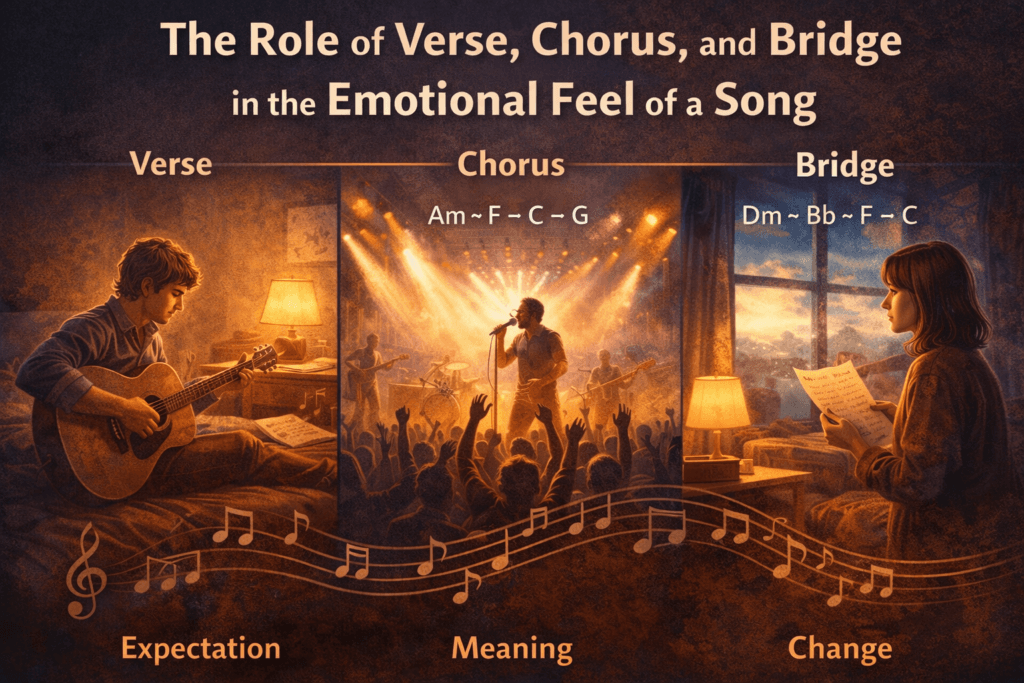
- Verse manages expectation
- Chorus delivers meaning
- Bridge renews attention
When musicians understand this, their playing changes. They stop treating every section equally. They begin to play with intention.
A verse played too aggressively steals from the chorus.
A chorus played too carefully weakens the message.
A bridge without emotional contrast becomes unnecessary noise.
Form teaches restraint.
Restraint creates impact.
Final Reflection
A song that feels right is rarely accidental.
Behind that feeling is a quiet agreement between verse, chorus, and bridge—each knowing when to speak, when to stay silent, and when to change direction.
When musicians stop seeing form as structure and start hearing it as emotion, their songs stop sounding assembled.
They start sounding alive.