
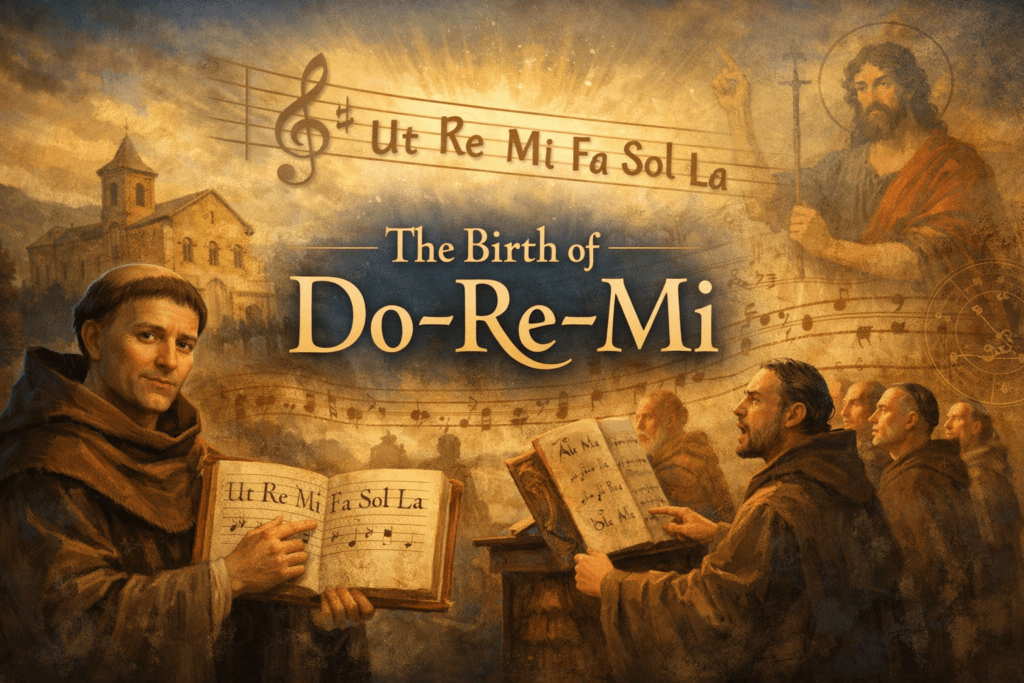
In the early Middle Ages, music was everywhere—and yet, paradoxically, it was unstable. Choirs filled monasteries with sacred chants, but the way those melodies were learned depended almost entirely on memory. A singer did not “read” music as we understand it today; he recalled it. One wrong interval, one forgotten leap, and an entire chant could collapse into confusion. This was the world into which Do–Re–Mi was born: not as a theory, not as a philosophical idea, but as a practical solution to a real musical crisis. Around the early 11th century, a simple but revolutionary concept emerged in Italy, quietly reshaping how humans understood, taught, and felt musical pitch.
To understand why Do–Re–Mi mattered, we must first ask the fundamental questions of history: what problem existed, where did it occur, who addressed it, when did it happen, why was it necessary, and how did it change music forever?
The Musical World Before Do–Re–Mi
(What existed before, and why it was chaotic)
Before the system we now call solmization, medieval European music relied on oral tradition. Gregorian chants—the dominant musical form of the time—were passed down by repetition. Written notation existed, but it was primitive. Early symbols called neumes floated above text, indicating the general direction of melody: up, down, or repeated. They did not specify exact pitch or interval.
This meant that two choirs singing the “same” chant in different regions could sound noticeably different. Pitch relationships were learned by habit, not by reference. There was no stable internal map of intervals—no clear sense of “this note is a step above that one.” Music lived in the body and memory, not on the page.
At this time, musical thinking was still deeply influenced by ancient Greek theory. Pitch was understood through ratios and modes rather than functional relationships. The church modes—Dorian, Phrygian, Lydian, Mixolydian—defined melodic behavior, but they did not offer a practical teaching tool. There was no central pitch equivalent to a modern tonic. Singers knew how a melody behaved, but not why it behaved that way.
In short, medieval music had structure, but lacked clarity. It had tradition, but no efficient system for education. This gap became increasingly problematic as monasteries expanded and choirs grew larger. Teaching music through pure memorization was slow, error-prone, and inconsistent.
The Context: Where and When the Problem Intensified
(Where and when change became unavoidable)
By the late 10th and early 11th centuries, monasteries across Europe were becoming centers of learning. Italy, in particular, played a crucial role. Monastic schools needed a faster, more reliable way to train singers—especially young novices with no prior musical background.
The demand was practical, not artistic. Church leaders wanted uniformity. Sacred music was not meant to vary wildly from place to place; it was meant to preserve theological meaning through sound. Musical inconsistency was not just an aesthetic issue—it was a liturgical one.
This is the environment in which a Benedictine monk and music teacher named Guido of Arezzo began to question the status quo.
The Turning Point: Who Changed the System, and Why
(Who, why, and what was introduced)
Guido of Arezzo was not trying to invent a new musical language. His goal was simpler: to help singers learn faster and more accurately. He observed that students struggled most with internalizing pitch relationships. They could memorize melodies, but they did not understand intervals.
Guido’s insight was radical in its simplicity. Instead of teaching melodies as fixed sequences, he proposed teaching relationships between notes. To do this, notes needed names—not absolute names like modern letter notation, but relative ones that reflected position within a pattern.
He found his solution in a hymn familiar to every singer of the time: Ut queant laxis, a chant dedicated to St. John the Baptist. Each phrase of the hymn began on a successively higher pitch. By assigning the first syllable of each line to its starting note, Guido created a ladder of pitch relationships:
Ut – Re – Mi – Fa – Sol – La
For the first time, singers could hear and name intervals as functional steps rather than abstract heights. Learning accelerated dramatically. According to historical accounts, what once took years to master could now be learned in months.
How Do–Re–Mi Solved the Chaos
(How the system worked in practice)
The power of Do–Re–Mi—originally Ut–Re–Mi—lay in its relativity. These syllables were not fixed pitches. Ut was not always the same frequency. Instead, Ut represented the starting point of a hexachord, a movable pattern of intervals.
This did something unprecedented: it trained the ear to recognize distance rather than absolute pitch. Singers no longer depended solely on memory. They developed an internal sense of stepwise motion, tension, and release.
This system also aligned perfectly with the emerging notational staff, another innovation Guido promoted. Pitch could now be seen and sung with precision. The chaos of regional variation began to fade, replaced by consistency and shared understanding.
Returning to the Core: Why Do–Re–Mi Matters
(Why this moment defines Western music)
The birth of Do–Re–Mi was not merely a teaching trick. It marked a shift in musical consciousness. Music moved from being something remembered to something understood. From this foundation, later developments became possible: harmony, counterpoint, chordal thinking, and eventually tonal music centered around a “home” pitch.
Centuries later, Ut would evolve into Do, and Si would be added to complete the seven-note scale. But the essence remained unchanged. Do–Re–Mi created a framework in which music could be analyzed, transmitted, and expanded without losing its emotional core.
What began as a solution to medieval confusion became the backbone of Western musical thought. Every chord progression, every sense of tension resolving to rest, still echoes that original need for clarity.
Conclusion
(The lasting answer to medieval chaos)
So when we ask why Do–Re–Mi was born, the answer is clear. It emerged when memory alone was no longer enough, where musical unity was required, who saw the problem and addressed it, what system replaced confusion, why consistency mattered, and how a simple set of syllables transformed music forever.
Do–Re–Mi was not an accident of history. It was a necessary response to chaos—one that still shapes how we hear, feel, and play music today.