Introduction: The Ancient Question About Music
Is music supposed to have words?
In modern culture, many people unconsciously assume that music is incomplete without lyrics. Popular songs dominate streaming platforms, radio stations, and social media, and most of them contain sung words that deliver stories, emotions, and messages. Because of this cultural habit, people often equate music with songs.
However, from a deeper musical, historical, and philosophical perspective, music itself does not require lyrics to exist, to communicate emotion, or to be meaningful.
In fact, if we trace the origins of music, examine the role of sound in human evolution, and study the nature of musical expression, we will discover something surprising:
Lyrics are not the foundation of music.
They are an additional layer placed on top of music.
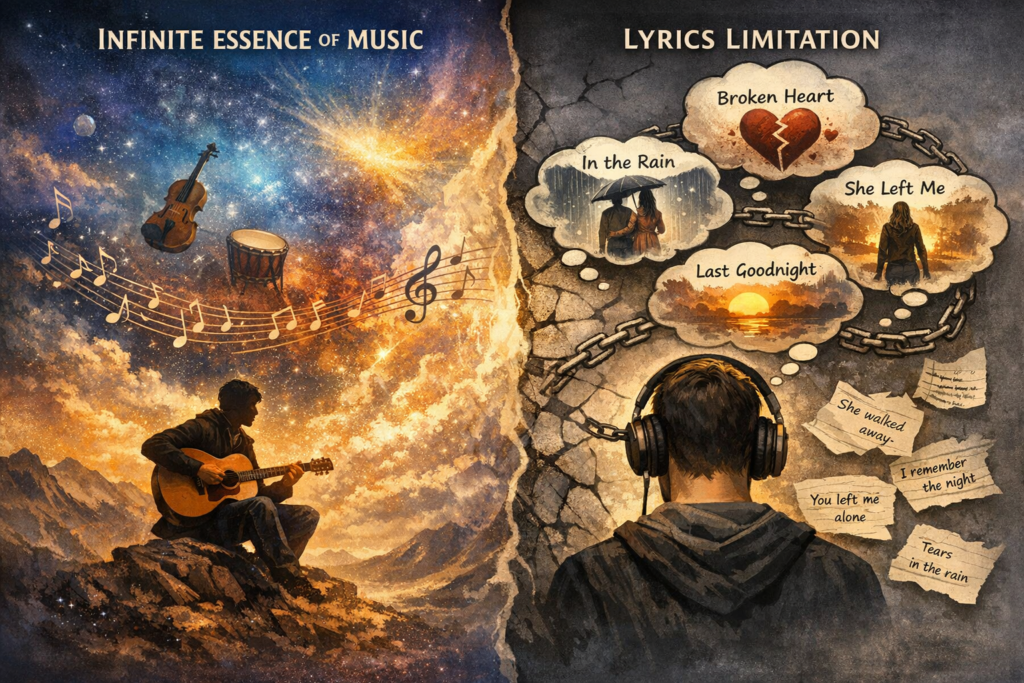
More importantly, lyrics can sometimes limit the interpretative freedom that pure music naturally provides.
This does not mean lyrics are useless. On the contrary, lyrics have many valuable functions. But when discussing the essence of music, we must recognize that music originally existed — and still exists — as a language beyond words.
To understand this fully, we need to travel through anthropology, music history, cognitive science, and musical practice.
The Origin of Music: Sound Before Language
Long before written poetry, literature, or lyrical songwriting existed, humans were already making music.
Archaeological evidence suggests that musical instruments appeared tens of thousands of years ago. One of the oldest known instruments is the bone flute discovered in Germany, estimated to be over 40,000 years old. These instruments were used to produce melodic sounds long before complex spoken languages developed.
Even more primitive forms of music likely existed earlier through:
- rhythmic clapping
- stomping feet
- striking stones or wood
- vocal humming without structured words
Anthropologists believe early humans used rhythmic sound for several purposes:
- Ritual communication
- Group bonding
- Coordinating movement
- Emotional expression
In these early musical activities, structured lyrics were not present. Instead, humans used pure sound, rhythm, and tone.
This strongly suggests that music predates lyrical language in cultural evolution.
Music as a Universal Language
One of the strongest arguments that music does not need lyrics lies in its universal intelligibility.
A person from Japan can listen to a symphony written in Austria centuries ago and still feel its emotional impact. A listener in Brazil can hear an instrumental soundtrack from a European film and understand its tension or sadness.
Why does this happen?
Because music communicates through acoustic patterns that interact directly with human perception and emotion.
These elements include:
- rhythm
- harmony
- timbre
- dynamics
- melodic contour
- harmonic tension and release
These musical components trigger emotional responses in the brain through neural systems related to anticipation, pattern recognition, and emotional processing.
When music rises in pitch and intensity, we perceive excitement or tension. When it resolves harmonically, we feel relief. When tempos slow down and harmonies soften, we often interpret calmness or sadness.
All of these responses occur without any need for linguistic explanation.
The Emotional Power of Instrumental Music
Throughout history, many of the most powerful musical experiences have occurred without lyrics.
Classical symphonies, film scores, jazz improvisations, and instrumental guitar compositions all demonstrate that music alone can convey complex emotional narratives.
A symphony orchestra can depict:
- tragedy
- triumph
- mystery
- joy
- longing
without a single word being spoken.
Film music provides an even clearer example. When watching a movie, audiences often react emotionally to scenes largely because of the instrumental score guiding their feelings.
The music tells the audience when something is heroic, dangerous, romantic, or tragic — even though no lyrics explain these emotions.
This proves that music itself carries emotional meaning independently of language.
The Infinite Interpretation of Pure Music
One of the most beautiful qualities of instrumental music is interpretative openness.
When music has no lyrics, listeners are free to attach their own memories, feelings, and meanings to the sound.
Two people listening to the same instrumental piece might imagine completely different emotional stories. One might hear nostalgia, another might hear hope, another might feel peaceful introspection.
This openness is not a weakness. It is actually one of music’s greatest strengths.
Music becomes a shared emotional space rather than a fixed narrative.
How Lyrics Narrow the Interpretative Space
When lyrics are introduced into music, something changes fundamentally.
Lyrics provide explicit semantic meaning. They describe specific situations, characters, or emotions. Instead of allowing listeners to create their own interpretations, lyrics guide them toward a particular narrative.
For example, if a song lyric says:
“I remember the night you left me in the rain.”
The listener’s imagination is directed toward a specific emotional scenario: heartbreak, separation, longing.
While this storytelling can be powerful, it also limits the range of possible interpretations.
Without lyrics, the same musical progression might evoke many different emotional images. With lyrics, the music becomes tied to the meaning of the words.
In this sense, lyrics can narrow the infinite expressive field of music into a defined narrative path.
Music as Pure Emotional Architecture
From a musical perspective, especially when analyzing harmony and chord progression, music operates like an architecture of emotion.
Chord relationships create emotional movement through tension and release.
For example, in Western tonal harmony:
- tonic chords create stability
- dominant chords create tension
- minor chords introduce introspective color
- suspended chords create anticipation
These emotional movements exist independently of language.
A progression such as:
C – G – Am – F
can evoke feelings of nostalgia or warmth even if no words accompany it.
The emotional arc emerges purely from harmonic structure.
Why Humans Still Add Lyrics
If music does not require lyrics, why are lyrics so common?
The answer lies in the human need for narrative and communication.
Lyrics provide several important functions:
1. Storytelling
Lyrics allow music to tell explicit stories about love, history, culture, or personal experiences.
2. Memorability
Words make songs easier to remember and share socially.
3. Cultural Identity
Lyrics preserve language, traditions, and social messages within musical forms.
4. Emotional Clarification
Lyrics help communicate very specific emotional states that music alone might leave ambiguous.
5. Social Participation
Songs with lyrics allow groups of people to sing together, creating communal experiences.
These functions explain why lyrical songs dominate popular music cultures.
However, these advantages do not change the fundamental truth:
Music itself does not depend on lyrics to exist or to communicate emotion.
The Coexistence of Music and Words
Rather than seeing lyrics as enemies of music, it is more accurate to view them as a different layer of expression.
Music without lyrics offers:
- emotional openness
- interpretative freedom
- universal communication
Music with lyrics offers:
- narrative storytelling
- linguistic meaning
- cultural messaging
Both forms serve different artistic purposes.
Instrumental music invites listeners into an emotional landscape where meaning is personal and fluid. Lyrical music guides listeners through a more defined emotional narrative.
Conclusion: The Essence of Music Beyond Words
Music is one of humanity’s oldest forms of expression. It emerged from rhythm, vibration, and sound long before language became structured enough to support poetic lyrics.
Because of this origin, music possesses a unique ability to communicate directly with human emotion without relying on words.
Lyrics can enrich music by adding narrative and cultural meaning, but they can also reduce the interpretative openness that pure music naturally provides.
In its deepest form, music is not a container for words.
It is a language of feeling, shaped by harmony, rhythm, and sound.
And in that pure sonic space — before language defines it — music remains infinite.