Learning guitar from zero without taking a formal course is not about being lazy or avoiding structure. It’s about building musical awareness first, not drowning in information. Many beginners quit not because guitar is hard, but because they learn it in the wrong order—too much theory, too little feel.
At TuneChord, we believe guitar should be learned the same way music is felt: slow, intentional, and connected to sound.
This guide is not a shortcut.
It is a clear path.
Start with Chords, Not Notes
Most beginners think learning guitar means memorizing notes on the fretboard. That comes later. What actually makes you play is chords.
Chords are:
- Harmony
- Rhythm
- Emotion
You don’t need 20 chords to start. You need a few chords played well.
Begin with:
- Major chords (happy, open sound)
- Minor chords (darker, emotional color)
But here’s the mistake:
👉 Do not rush to change chords fast.
Instead, focus on:
- Clean sound
- Finger pressure
- Letting every string ring properly
Speed comes naturally after control.
Finger Pain Is Normal — Noise Is Not
Your fingers will hurt. That’s normal.
Buzzing strings and dead notes are not something to ignore.
Pain disappears with time.
Bad habits stay longer.
Train your fingers slowly:
- Press close to the fret
- Relax your wrist
- Stop squeezing too hard
If your chord sounds noisy, don’t move on. Fix it.
A clean chord played once is better than a dirty chord played fast.
Strumming Is Feel, Not Pattern
Many beginners ask: “What strumming pattern should I use?”
Wrong question.
Strumming is not a formula.
It is how your hand reacts to rhythm.
Start with:
- Simple downstrokes
- Even tempo
- Consistent volume
Then learn to:
- Accent certain strokes
- Play softer or louder
- Leave space between strokes
Music breathes.
Your strumming should too.
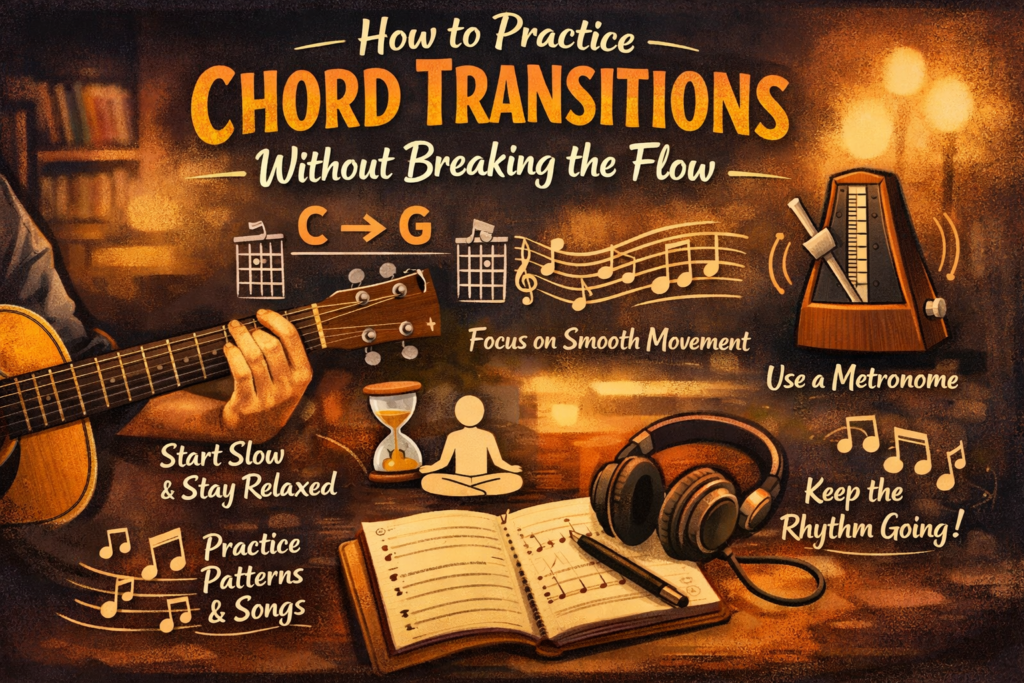
Learn to Change Chords Slowly
Fast chord changes look impressive but mean nothing if they sound broken.
Practice transitions like this:
- Stop strumming
- Change chord slowly
- Check every string
- Strum once
- Repeat
This trains:
- Muscle memory
- Finger independence
- Accuracy
Speed is a result, not a goal.
Play Songs Early — Even Badly
Do not wait until you feel “ready.”
Songs are the reason you picked up the guitar.
Choose:
- Slow songs
- Few chords
- Simple rhythm
Play them imperfectly, but play them fully.
Songs teach you:
- Timing
- Structure
- Musical flow
Exercises build hands.
Songs build musicians.
Practice Short, Practice Daily
One hour once a week is worse than 10 minutes every day.
Your hands learn through repetition, not exhaustion.
Ideal beginner routine:
- 5 minutes: finger warm-up
- 5 minutes: chord clarity
- 5 minutes: strumming feel
- 5 minutes: song application
That’s enough.
Consistency beats motivation.
Listen More Than You Play
This is rarely taught.
Listening trains your musical instinct.
Listen for:
- Chord changes
- Dynamics
- Rhythm feel
- Emotional shifts
Try to feel why a chord works, not just what chord it is.
Music is not math.
It is reaction.
You Don’t Need a Course — You Need Direction
Courses give structure.
But structure without awareness leads to mechanical playing.
You can learn guitar from zero without a course if you:
- Focus on sound, not speed
- Respect fundamentals
- Build feel alongside technique
- Stay patient with your progress
Guitar is not conquered.
It is grown.
Final Thought (TuneChord Philosophy)
A chord is not just finger placement.
It is pressure, timing, space, and intention.
When you learn guitar this way, you don’t just play chords.
You understand why they feel the way they do.
That is real progress.
That is TuneChord.