From a purely technical guitarist’s perspective, this song gives you almost nothing to hide behind.
No modulation.
No flashy transitions.
No harmonic tricks meant to impress.
And that is exactly why it works.
This is not a song built to show emotion.
It is a song built to leave emotional space.
1. Simple Chords, but a Ruthless Harmonic Function
In the common key of G, the core progression is:
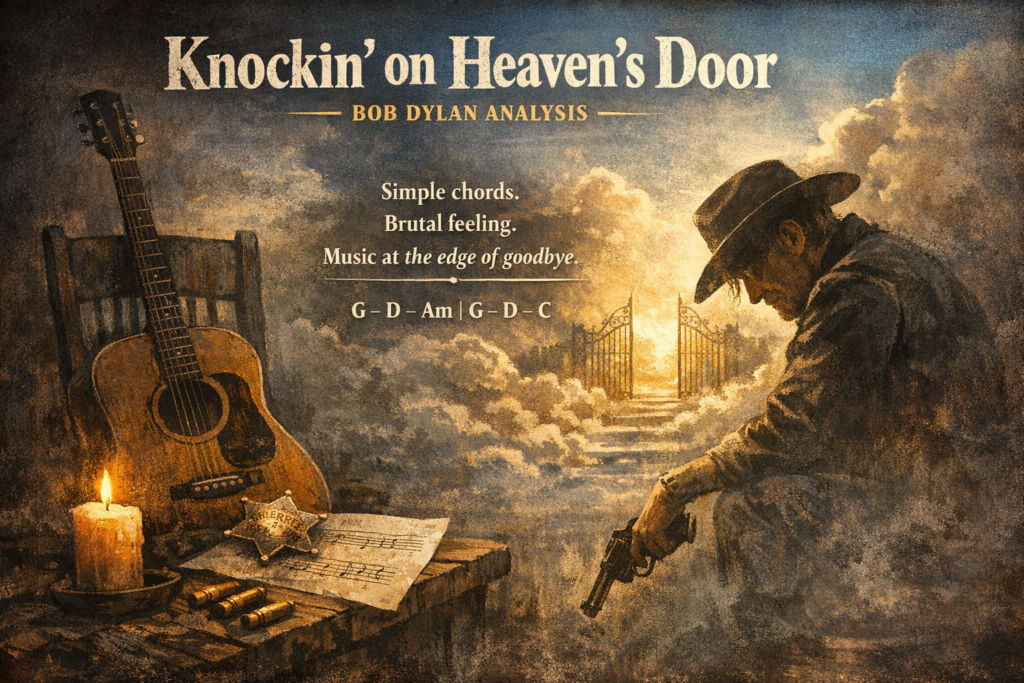
G – D – Am | G – D – C
On paper, this looks harmless. But functionally, it’s deceptive.
- G → D establishes safety: tonic to dominant, familiar and grounded.
- D → Am is the crucial move. Instead of resolving “correctly,” it falls inward. This is not sadness—it’s emotional withdrawal.
- Am → G returns home, but without relief.
- D → C avoids a strong cadence, landing on something that feels unfinished.
What almost no theory breakdown mentions:
this song deliberately avoids emotional closure.
There is no moment where the harmony says “this is the end.”
That’s why the song feels suspended—like waiting for an answer that never comes.
2. The Feel Is Not “Sad” — It’s Emotional Exhaustion
Many descriptions label this song as sad. That’s inaccurate.
Sadness still wants a response.
This song doesn’t.
The emotional color here is post-emotion:
- after anger
- after fear
- after resistance
Notice what Dylan doesn’t use:
- No diminished chords
- No dramatic minor cycles
- No tension-heavy harmony
Major and minor appear almost neutrally, stripped of drama.
The harmony isn’t crying—it’s tired.
That emotional neutrality is far more disturbing than obvious sadness.
3. The Historical Context That Locks the Feel in Place
This song was written for the 1973 film Pat Garrett & Billy the Kid.
The narrator is a dying sheriff.
The line:
“Mama, take this badge off of me”
is not symbolic poetry.
It’s literal. The badge no longer matters because life is ending.
Understanding this changes everything:
- The lack of harmonic movement makes sense
- The repetition becomes intentional, not lazy
- The song feels less like storytelling and more like a final breath
A dying man does not need harmonic sophistication.
He needs honesty.
4. Why Did This Song Become Global with Such Minimal Chords?
Because it doesn’t behave like a “song.”
It behaves like:
- a prayer
- a chant
- a quiet confession
Psychologically, this is powerful:
- The listener’s brain isn’t busy decoding harmony
- There’s no musical agenda being pushed
- The emotional space remains open
That space invites the listener to step inside.
This is the hidden truth:
Simple chords don’t limit emotion—they invite participation.
5. The Biggest Mistake Guitarists Make with This Song
Most players ruin this song by playing it too well.
Common mistakes:
- Clean, symmetrical strumming
- Perfect timing
- Consistent dynamics
All of that kills the feel.
This song needs:
- Micro-delays before chord changes
- Uneven strums
- Slight rhythmic hesitation
It should feel like the hands are heavier than usual.
Like the guitar is being played by someone who has nothing left to prove.
Precision makes this song polite.
Imprecision makes it human.
6. Why the Chords Feel “Empty” (and Why That’s the Point)
The harmony here doesn’t guide emotion—it refuses to.
Think of the chords as a bare floor:
- No furniture
- No decoration
- Just enough structure to stand on
The lyrics carry the weight.
The chords simply refuse to interfere.
This is why the song survives across genres:
- folk
- rock
- gospel
- reggae
- acoustic solo performances
When harmony steps back, meaning steps forward.
7. The TuneChord Perspective: What No One Says Clearly
This song isn’t popular despite its simplicity.
It’s popular because the simplicity is emotionally honest.
There is no harmonic manipulation here.
No attempt to steer the listener’s feelings.
The chords don’t explain anything.
They wait.
And that waiting—unresolved, unpolished, and unafraid of silence—is what makes the song timeless.
Final Thought
Knockin’ on Heaven’s Door teaches a rare musical lesson:
Sometimes the strongest musical decision
is knowing when to stop speaking.