
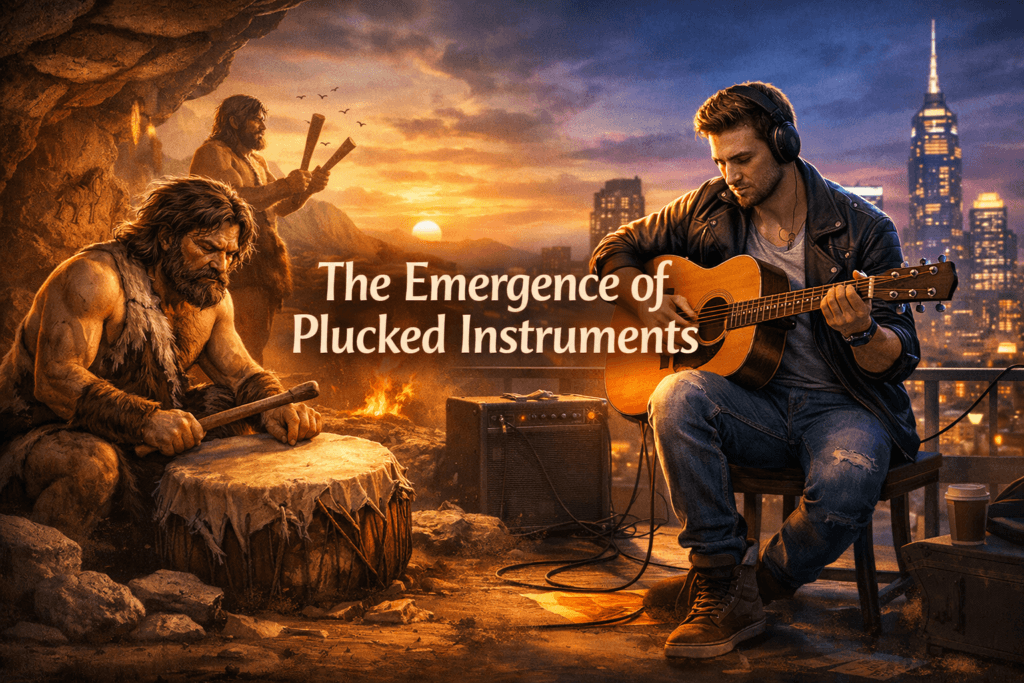
Long before music learned how to tell stories, it learned how to breathe.
The earliest music created by humans was not melodic, not harmonic, and certainly not based on chords. It was rhythmic. Music began as motion—hands striking surfaces, feet stamping the ground, stones colliding, wood resonating. This was music as time, not pitch. Music as survival, ritual, coordination, and collective pulse.
This is where percussion ruled alone.
But at a certain point in human history—quietly, without fanfare—music crossed a threshold. Sound stopped being only about when something happened, and began to care about which sound happened. That moment marks the most important transition in music history: the birth of plucked-string instruments.
This transition did not merely add new sounds.
It changed the nature of music itself.
Music Before Strings: When Rhythm Was Everything
Percussion-based music required no tools beyond the body and the environment. Anyone could participate. Everyone could feel it. Rhythm synchronized communities long before written language existed.
Anthropologically, rhythm served essential purposes:
- Coordinating group movement
- Strengthening social bonds
- Supporting ritual and trance states
- Regulating labor and ceremonies
At this stage, music had no fixed pitch system. Sound was expressive, but not precise. You could feel intensity, speed, repetition—but not melody in the modern sense. There was no concept of interval, no tension between notes, no emotional contrast created by harmony.
Music lived entirely in time, not in space between pitches.
The Quiet Revolution: When Humans Began to Control Pitch
The leap from percussion to plucked strings did not happen suddenly. It required multiple layers of human understanding:
- Discovering that stretched materials vibrate predictably
- Learning that tension changes pitch
- Realizing that pitch can be chosen, not accidental
- Building resonant bodies to amplify sound
This breakthrough emerged around 3000–2500 BCE, most clearly documented in ancient Mesopotamia. Archaeological reliefs and artifacts from cities like Ur depict lyres and harps—stringed instruments intentionally designed to produce distinct pitches.
For the first time, humans could:
- Repeat the same note at will
- Compare one pitch to another
- Create relationships between sounds
This was the birth of interval awareness.
And intervals are the seeds of harmony.
Why Plucked Instruments Changed Music Forever
Plucked-string instruments introduced something radical: musical choice.
With percussion, expression depended on force and timing. With strings, expression depended on selection. Which string. Which pitch. Which relationship.
This single change unlocked:
- Melodic contour
- Emotional contrast
- Musical memory
- The foundations of scales
- The eventual emergence of chords
Music stopped being only collective movement and became individual expression.
A plucked string could whisper.
It could sustain.
It could suggest longing, joy, or tension.
These were emotional dimensions percussion alone could not articulate with precision.
From String to Structure: The Long Road to Harmony
Early string instruments were not harmonic tools yet. They were melodic. But once humans noticed that certain pitch combinations felt stable while others felt unresolved, a new musical intuition emerged.
This intuition—long before theory—led to:
- Preferred intervals
- Repeating tonal centers
- Proto-scales
- Eventually, harmonic thinking
Thousands of years later, this line of development would give birth to:
- Lutes
- Oud
- Harps
- Guitars
Every modern chord progression traces its ancestry back to that first moment when someone realized:
“This string sounds different from that one.”
The Artistic Consequence: Music Learned to Tell Stories
Percussion gives music energy.
Strings give music direction.
When pitch became controllable, music gained narrative power. Songs could now:
- Begin in tension
- Travel through contrast
- Resolve emotionally
This is the origin of musical storytelling.
Harmony is not a technical invention—it is an emotional one. It exists because humans needed sound to mirror internal states, not just external movement.
In this sense, plucked instruments transformed music from ritual function into artistic language.
The Hidden Truth: Rhythm Never Left
Importantly, this transition did not replace percussion. It integrated it.
Even today:
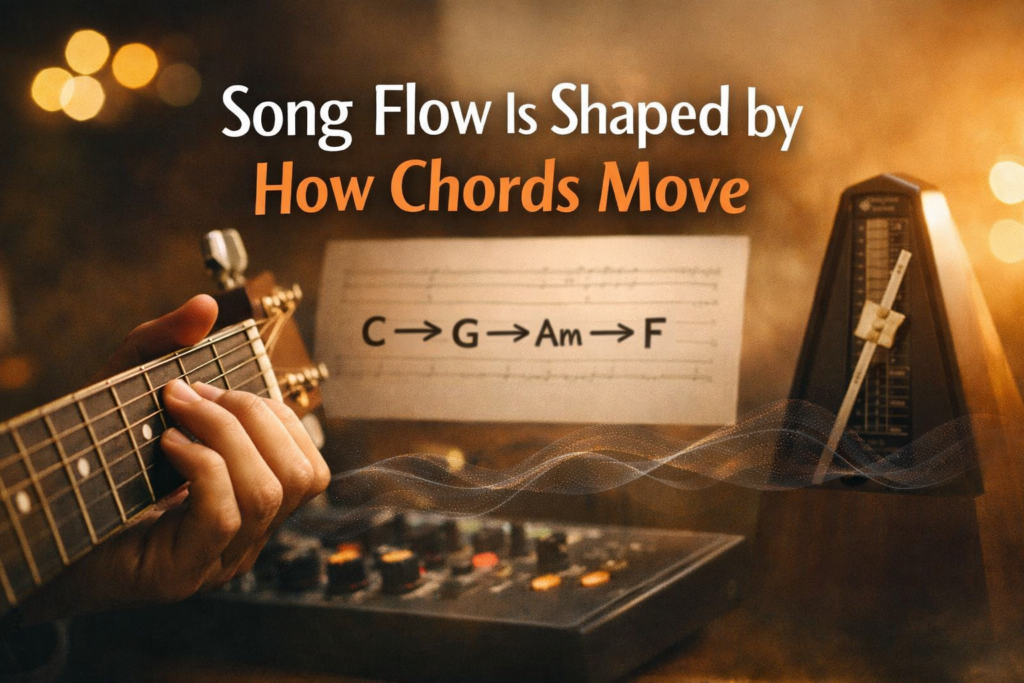
- Chords depend on rhythm to feel alive
- Harmony collapses without timing
- Groove defines how chords are perceived
Modern guitar playing still contains percussion:
- Strumming patterns
- Palm muting
- Percussive attacks
- Rhythmic subdivisions
The oldest musical instinct—rhythm—remains embedded inside the newest harmonic structures.
From Ancient Strings to Modern Chords
When you play a chord today, you are not just stacking notes. You are participating in a 5,000-year-old transformation:
- From instinct to intention
- From time to pitch
- From movement to meaning
The transition from percussion to plucked strings was not a technological upgrade.
It was a philosophical shift in how humans relate to sound.
Music stopped only marking time.
It began shaping emotion.
And everything we call harmony, chords, and songwriting today exists because of that moment when music learned to choose its own notes.
HXXYzvYXszWHhXJjR