

Some songs are written to succeed.
Others are written to survive.
Creep belongs to the second category.
It was not designed to be iconic. It was not crafted to dominate radio. It was not meant to define a generation. Yet somehow, this painfully honest song became the gateway through which the world first met Radiohead.
And that success came with a cost.
Born from Insecurity, Not Ambition
“Creep” was written by Thom Yorke during his university years. The song did not begin as a band statement or a career move. It began as a moment of emotional exposure.
Yorke has described the song as being inspired by intense feelings of inadequacy—watching someone he admired from a distance, feeling invisible, unwanted, and fundamentally unworthy.
The line
“I’m a creep, I’m a weirdo”
is not poetry dressed as confession.
It is the confession.
This is crucial to understanding the song’s power:
“Creep” does not ask for sympathy. It admits weakness.
A Simple Chord Progression with a Violent Emotional Turn
Musically, “Creep” looks harmless on paper. Its main progression is famously simple:
G – B – C – Cm
But inside that simplicity lies discomfort.
In the key of G major, B major does not belong.
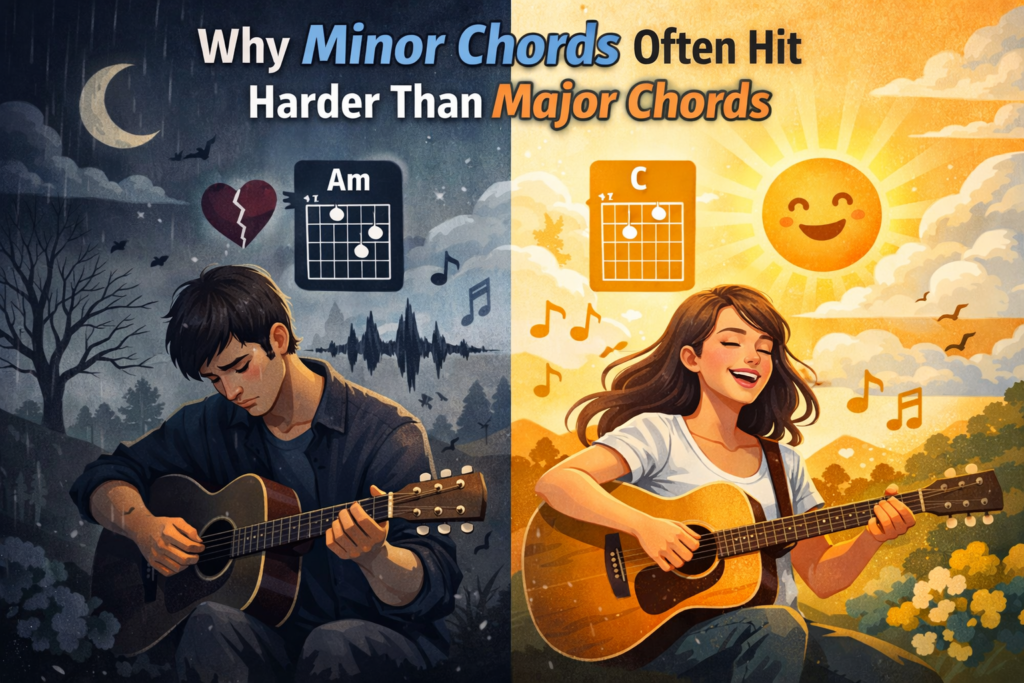
The sudden shift from C major to C minor is emotionally jarring. It feels like the floor collapsing under your feet.
From a TuneChord perspective:
- FORM: Extremely simple
- FEEL: Unstable, self-critical, unresolved
- FUNCTION: To mirror emotional collapse
This chord movement is not clever for the sake of theory.
It sounds wrong because the feeling is wrong.
The Accidental Sound That Defined the Song
One of the most iconic elements of “Creep” is the explosive distorted guitar hits before the chorus. Ironically, they were born from resistance.
Jonny Greenwood reportedly disliked the song during early sessions, feeling it was too soft, too sentimental. During recording, he intentionally struck the strings aggressively, almost sabotaging the gentle build-up.
Instead of ruining the track, he created its defining moment.
Those raw, violent strums:
- Shock the listener awake
- Mark the emotional rupture
- Turn vulnerability into confrontation
This was not calculated brilliance.
It was emotional friction captured on tape.
Rejection, Failure, and a Strange Revival
When “Creep” was first released in the UK, it failed. Radio stations refused to play it, labeling it too depressing and unsuitable for mainstream audiences.
But across the Atlantic, college radio stations in the United States embraced it.
Without marketing strategy or hype, “Creep” spread organically. Listeners recognized themselves in its discomfort. By the time the UK reconsidered, the song had already become unavoidable.
Success arrived late—and awkwardly.
A Song That Built a Career and Became a Burden
“Creep” opened every door for Radiohead:
- Record deals
- International tours
- Global recognition
But it also locked them into an identity they never wanted.
For years, Radiohead distanced themselves from the song. They avoided playing it live. They resented how audiences demanded it while ignoring their artistic evolution.
Why?
Because “Creep” represented a version of themselves they had already outgrown—but the world refused to let go.
This tension shaped Radiohead’s future. Their later work became increasingly experimental, almost as if to prove they were more than the song that made them famous.
Why “Creep” Still Resonates
Decades later, “Creep” refuses to disappear.
Not because it is musically complex.
Not because it is technically impressive.
But because it speaks a truth most people never say out loud.
It captures:
- Social alienation
- Romantic inadequacy
- The fear of not belonging
From a TuneChord standpoint, this is why beginners and non-musicians are drawn to it:
- The chords are playable
- The emotion is universal
- The song feels honest, not performed
TuneChord Insight
“Creep” is not a love song.
It is a song about believing you are unlovable.
Its power comes from alignment:
- Simple form
- Broken harmony
- Unfiltered emotion
Nothing is exaggerated. Nothing is hidden.
Final Thoughts
“Creep” is a rare example of a song that succeeded against its creator’s intentions.
It was born from insecurity.
Shaped by internal conflict.
Rejected before being embraced.
Loved by the world, yet complicated for the band that created it.
And perhaps that is why it endures.
Because at some point in life, almost everyone has felt like a creep.
And this song had the courage to say it first.

Pingback: Learn Guitar from Zero Without a Course – TuneChord – All About Chords, Feel, and Progression
Yes, slowly but precisely