For many beginners, learning guitar chords feels harder than it should. On the surface, it looks simple: press the strings, strum, and suddenly you can play songs. But in reality, fingers hurt, chords buzz, transitions feel slow, and the guitar never sounds like the one in your head.
This doesn’t mean you lack talent.
It means you’re facing the natural friction between hands, strings, and musical understanding.
Most beginners are taught chord shapes, but not how chords work or feel in real music.
1. Finger Pain That Kills Motivation
The Problem:
Almost every beginner complains about sore fingertips. The pain feels sharp, uncomfortable, and often leads to quitting early.
Why It Happens:
- Pressing strings too hard
- Using the flat part of the finger instead of the fingertip
- Hands not yet adapted to string tension
How to Fix It:
- Press only as hard as needed for the note to sound clean
- Use the tip of the finger, not the side
- Practice consistently in short sessions (10–20 minutes)
Finger pain is normal.
Quitting before your hands adapt is the real problem.
2. Buzzing or Muted Strings
The Problem:
The chord shape looks correct, but:
- Some strings don’t ring
- There’s buzzing noise
- The chord sounds weak or messy
Why It Happens:
- Fingers accidentally touch neighboring strings
- Thumb position is incorrect
- Wrist angle is too straight
How to Fix It:
- Curve your fingers naturally, as if holding a small ball
- Keep the thumb behind the neck, not over it
- Slightly angle your wrist to create space for clean notes
Practice one chord at a time and pluck each string individually before strumming.
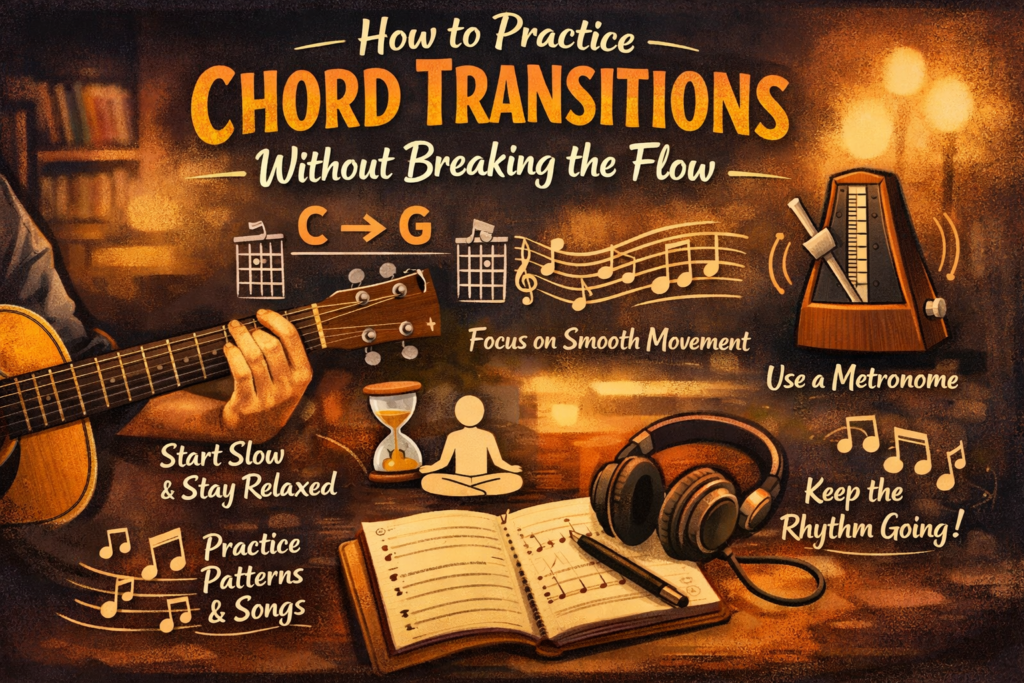
3. Slow and Awkward Chord Transitions
The Problem:
Every chord change feels like a stop sign. Rhythm collapses, and playing becomes stressful.
Why It Happens:
- Memorizing chord shapes as static positions
- Moving fingers one by one
- Not recognizing anchor fingers
How to Fix It:
- Identify fingers that stay in place between chords
- Practice transitions without strumming
- Use a slow metronome and build control first
Speed comes later.
Clean movement comes first.
4. Learning Too Many Chords Too Fast
The Problem:
Beginners often try to learn every chord type at once: major, minor, barre, seventh, suspended, and more. This leads to confusion and burnout.
Why It Happens:
- No learning priority
- Focusing on chord lists instead of music
- Learning without song context
How to Fix It:
Start with:
- Basic major and minor chords
- Chords commonly used in songs
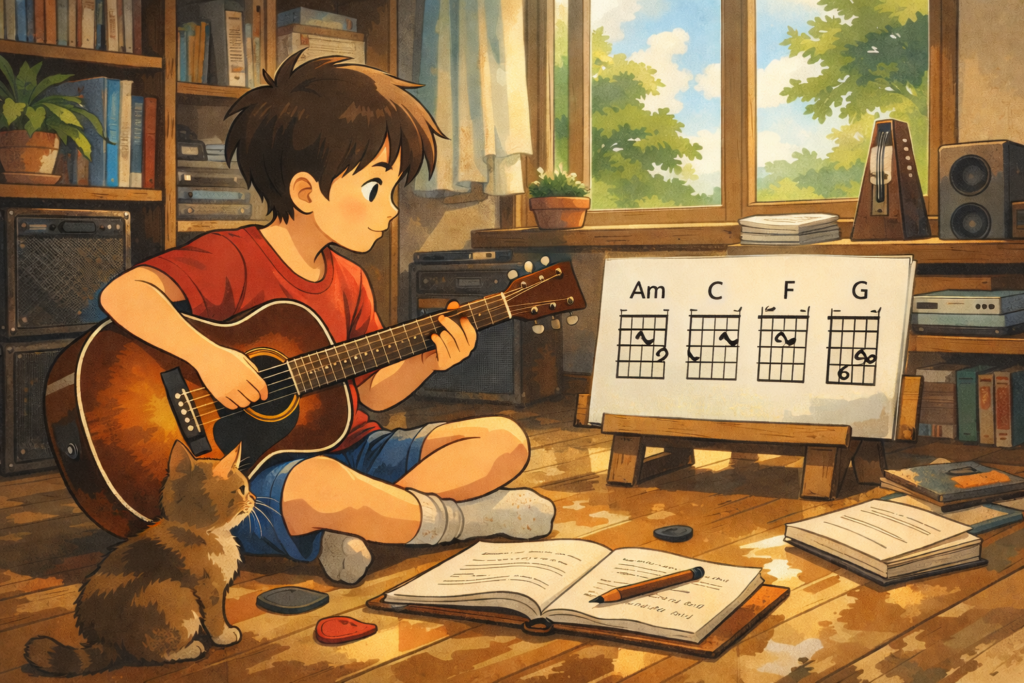
- Simple progressions with three or four chords
Learn chords through songs, not spreadsheets.
5. Chords Are Correct, But the Song Feels Empty
The Problem:
Technically everything is right, but the music feels flat or lifeless.
Why It Happens:
- Inconsistent strumming
- No awareness of rhythm dynamics
- Playing every chord with the same intensity
How to Fix It:
- Listen carefully to the original song
- Notice where strumming is lighter or stronger
- Let rhythm guide your chord pressure
Chords are shapes.
Music is movement.
6. Fear of Making Mistakes
The Problem:
Beginners often play stiffly because they’re afraid of hitting wrong notes or forming chords incorrectly.
Why It Happens:
- Too much focus on theory early on
- Fear of sounding bad
- Lack of exploration
How to Fix It:
- Allow yourself to sound bad at first
- Prioritize comfort and feel
- Learn theory after your hands and ears connect
Mistakes are part of muscle memory, not failure.
7. Inconsistent Practice Habits
The Problem:
Strong motivation at the beginning fades quickly. Practice becomes irregular or stops completely.
Why It Happens:
- Unrealistic expectations
- Sessions that feel too difficult
- No sense of progress
How to Fix It:
- Set small, achievable goals
- Practice daily, even briefly
- Acknowledge small improvements
Ten minutes a day beats two hours once a week.
TuneChord Insight
Beginners don’t struggle because chords are difficult.
They struggle because chords are learned without understanding their musical role.
Guitar progress happens when your hands, ears, and sense of rhythm start working together.
Final Thoughts
If you’re a beginner and you feel:
- Your fingers hurt
- Chords sound messy
- Transitions are slow
- Songs don’t feel right
You are not failing.
You are learning the correct way.
Slow down. Stay consistent. Listen more.
The sound will follow.