
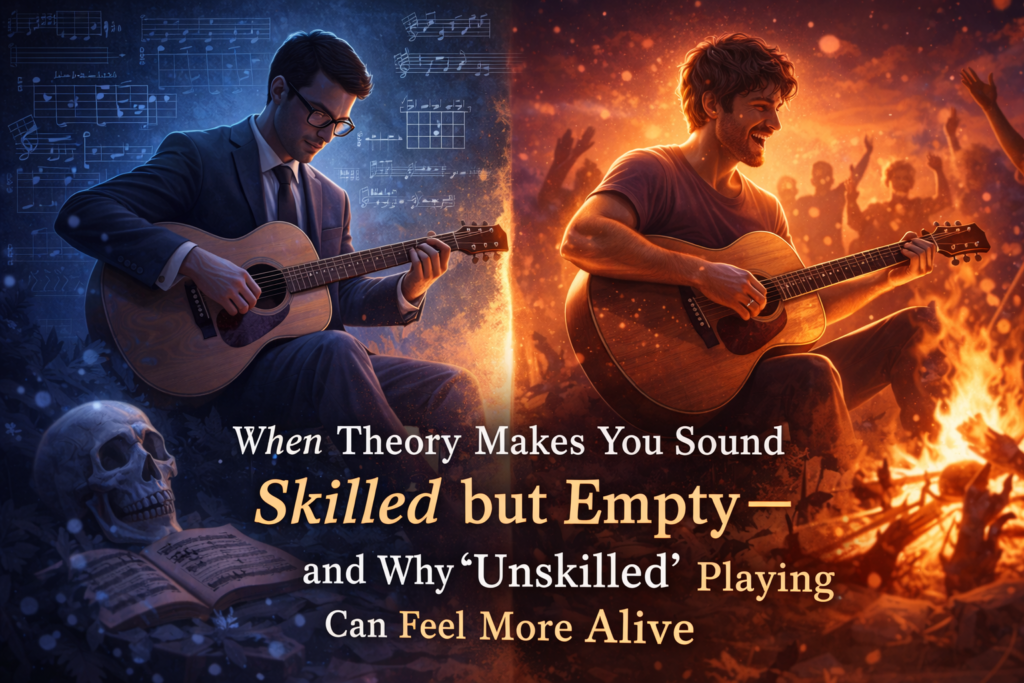
There is a quiet paradox in the guitar world that almost every honest musician eventually encounters.
You practice more.
You understand more theory.
Your playing becomes cleaner, faster, more correct.
Yet somehow… it feels less alive.
At the same time, you hear someone else play:
- sloppy transitions
- imperfect timing
- limited vocabulary
And still — it hits you.
It feels like music.
This is not imagination.
This is not nostalgia.
This is a real musical phenomenon — and understanding it changes how you play forever.
1. The Illusion of Progress: When “Better” Playing Loses Weight
Music education quietly trains us to equate progress with:
- accuracy
- consistency
- correctness
- theoretical justification
All of these are useful. None of them are emotional.
A guitarist who leans too heavily on theory often ends up playing to avoid mistakes, not to express something. The hands become obedient, but the intent disappears.
The result is not bad playing.
It’s neutral playing.
Neutral music is technically impressive and emotionally invisible.
2. Theory Is a Map — Not the Experience
Theory explains why something works after it already works.
But many players reverse the process:
They try to think their way into feeling.
That rarely succeeds.
Music does not live in concepts like:
- modes
- scale degrees
- chord function
Those are analytical tools, not emotional triggers.
When you play while actively thinking in theory, your brain prioritizes control, not connection. The body stiffens. The timing locks to a grid. The music loses breath.
3. Why “Unskilled” Playing Often Feels More Honest
Players with limited technique are forced into a different relationship with music.
They cannot:
- over-explain
- over-ornament
- over-correct
So they do something far more powerful:
they commit.
They commit to:
- a rhythm
- a chord
- a moment
Even if it’s imperfect.
That commitment creates direction, and direction creates feel.
Listeners do not respond to accuracy.
They respond to intent.
4. Feel Lives in Micro-Imperfection
Real feel exists in places theory does not measure:
- the chord change that arrives a fraction late
- the note that lingers slightly too long
- the strum that lands heavier than planned
- the silence that lasts longer than “correct”
These are not mistakes.
They are human timing decisions.
Perfect symmetry sounds mechanical.
Human asymmetry sounds alive.
5. The Hidden Cost of Playing “Correctly”
Many advanced players unconsciously perform for other musicians, not for listeners.
This leads to:
- showing vocabulary instead of meaning
- filling space instead of letting it breathe
- proving competence instead of communicating emotion
Music becomes a résumé, not a conversation.
Ironically, audiences with no musical training detect this instantly. They may not know what is missing, but they feel that something is.
6. Why Theory Can Silence Emotional Instinct
When theory dominates, it creates fear:
- fear of wrong notes
- fear of bad choices
- fear of sounding simple
Fear kills risk.
Risk creates feel.
The most emotional performances often include moments that would look “wrong” on paper:
- unresolved harmony
- uneven phrasing
- raw dynamics
But emotionally, they are right.
7. The Difference Between Knowing and Deciding
Great players don’t know more theory.
They decide more clearly.
They decide:
- when to repeat
- when to stop
- when to leave space
- when not to show what they know
Decision-making is emotional.
Knowledge is neutral.
Feel emerges when decisions are made from listening, not from calculation.
8. Why Clean Playing Often Sounds Cold
Clean technique removes friction.
But friction is where emotion lives.
When everything is:
- perfectly timed
- evenly voiced
- dynamically balanced
the music becomes predictable.
Predictability comforts the mind, but emotion needs tension.
Not harmonic tension — human tension.
9. The Role of the Body in Feel
Feel is not intellectual.
It is physical.
It lives in:
- breathing
- hand weight
- muscle relaxation
- micro-tension and release
Theory happens in the head.
Feel happens in the body.
If your playing does not involve your body, it will never fully involve the listener.
10. The TuneChord Perspective: The Truth Most Lessons Avoid
Technique teaches you how to play notes.
Feel teaches you why the notes exist.
Theory should serve feel — never replace it.
The moment theory becomes the driver instead of the assistant, music loses its soul.
The goal is not to abandon theory.
The goal is to silence it while playing.
Think before.
Analyze after.
But while playing — listen.
11. A Simple Test to Know Where You Are
Ask yourself honestly:
- Are you playing to sound right?
- Or playing to say something?
If your hands feel tense, your music is probably tense.
If your mind is busy, your music is probably cautious.
Feel requires vulnerability.
And vulnerability requires letting go of control.
Final Thought
At some point in every guitarist’s journey, progress stops sounding like progress.
That is not failure.
That is the doorway.
Beyond that door is a different skill:
not playing more,
not knowing more,
but trusting less thought and more instinct.
Because in the end:
Music doesn’t care how much you know.
It cares how much you mean what you play.