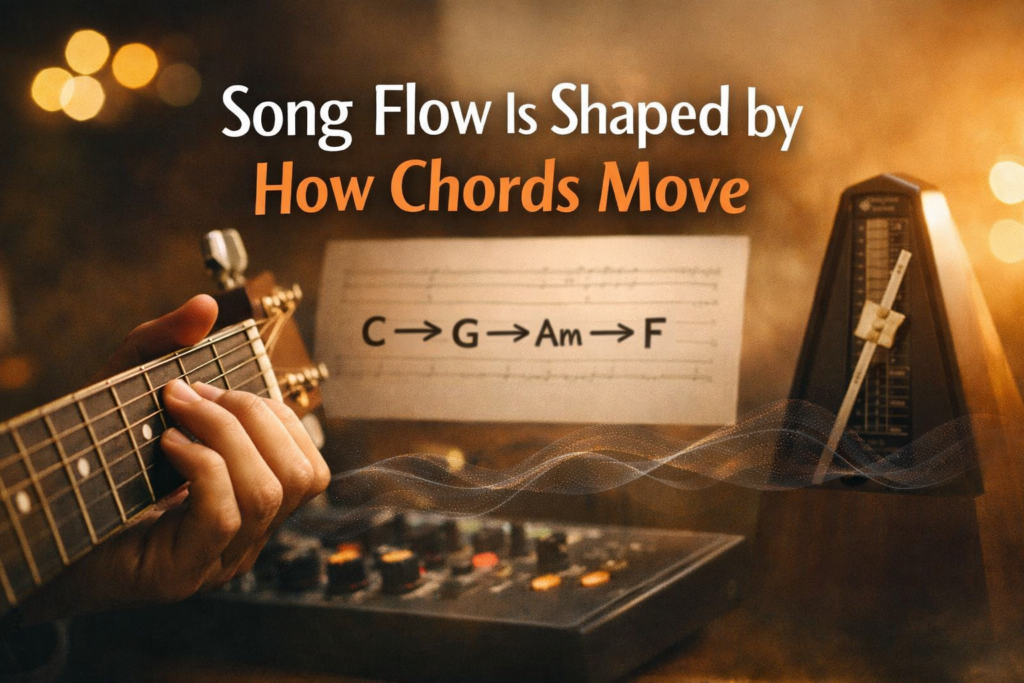
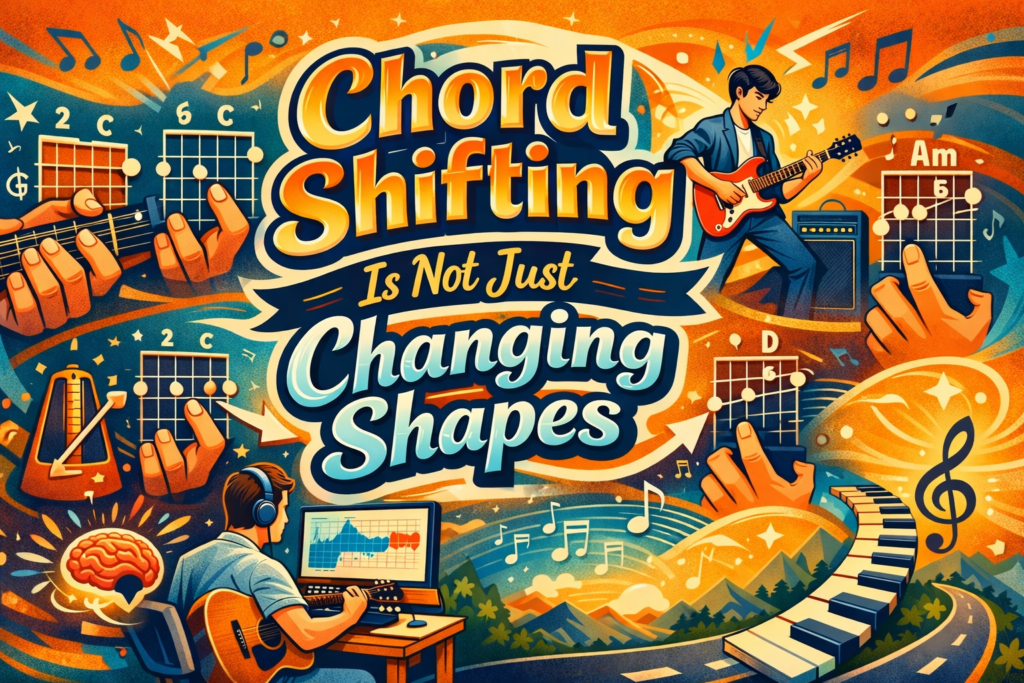
Many guitar players believe that shifting chords is simply about moving fingers from one shape to another. Learn the diagram, practice the transition, repeat until it’s fast enough. On the surface, this sounds logical. But musically, it misses the point.
Chord shifting is not a mechanical action.
It is a musical decision.
When you treat chord changes as shape changes, the result often sounds stiff. The rhythm breaks, the groove disappears, and the music feels segmented. But when you understand shifting as part of the musical flow, everything changes.
Chord Shifting Is About Continuity, Not Speed
Most players chase speed when practicing chord changes. Faster transitions, tighter movements, cleaner switches. Speed matters—but only after continuity is understood.
A good chord shift does not announce itself.
It feels invisible.
The listener should not notice the moment you change chords. They should only feel that the music continues naturally. This happens when you think beyond shapes and start listening to what the chord is becoming, not just what it is.
Every Shift Has Emotional Weight
Each chord carries tension, release, or stability. When you move from one chord to another, you are guiding emotion forward.
Ask yourself:
- Is this chord resolving something?
- Is it creating anticipation?
- Is it supposed to feel sudden or smooth?
If your hands move without answering these questions, the shift will sound random—even if it’s technically correct.
Why Good Players Sound Smooth with Simple Chords
You’ve probably noticed it: experienced players can sound expressive with only three or four chords. The secret is not variety. It’s intention.
They don’t “jump” between shapes.
They connect them.
Often, one finger leads the shift. Sometimes a string rings slightly longer. Sometimes there’s a controlled silence. These small decisions turn a chord change into a musical sentence instead of a cut.
Shifting Starts in the Ear, Not the Hand
If you practice shifting by staring at your fingers, progress will be slow. Your hands will always be late.
Instead, train your ear to anticipate the next chord. When you already hear where the music is going, your fingers move with purpose. The shift becomes a response, not a reaction.
This is why slow practice is powerful. At slow tempo, every shift is exposed. You hear the gap, the hesitation, the tension. And that awareness is what builds flow.
Final Thought
A chord shape is static.
Music is movement.
If you want your playing to feel alive, stop thinking of chord shifting as changing forms. Start treating it as guiding the music from one feeling to the next.
Because great chord shifting is not about where your fingers go—
it’s about where the music wants to move.