
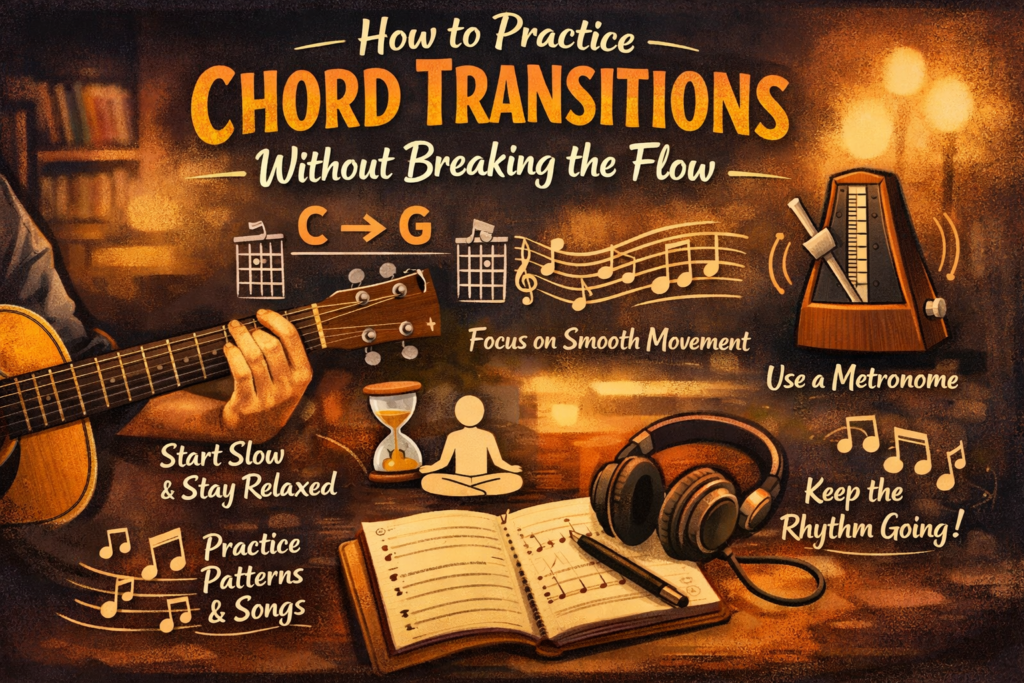
One of the most common problems when playing chords is not wrong notes,
but chord transitions that break the flow.
The sound suddenly stops, the rhythm collapses, and the feeling of the song disappears.
In reality, smooth chord transitions are not about speed.
They are about hand habits, mental preparation, and continuity of sound.
This article will not tell you to “play faster.”
It will show you how to practice chord transitions without breaking the flow.
Why Do Chord Transitions Often Break the Flow?
Before practicing, understand the real causes:
- All fingers are lifted at once
- Fingers move individually without direction
- Focus jumps to the next chord shape, not the current sound
- The mind pauses every time the chord changes
The problem is not your fingers.
It is how you move between sounds.
The Core Principle: Never Let the Sound Go Empty
The biggest mistake in chord transitions is this:
lift all fingers → silence → press the next chord
To practice smooth transitions, you must eliminate the silent gap.
Think of it this way:
- one finger keeps touching the strings
- one string keeps vibrating
- one musical feeling keeps moving forward
Good chord transitions do not feel empty in the middle.
Practice 1: Find the Anchor Finger
Choose any two chords.
Look carefully:
- is there one finger that can stay on the same string?
- or remain on the same fret?
Practice like this:
- Do not lift all fingers
- Keep the anchor finger in place
- Let the other fingers move around it
The anchor finger is the bridge between chords.
Practice 2: Move Without Sound First
This exercise feels strange, but it works.
- Form the first chord
- Release pressure, keep fingers touching the strings
- Move to the next chord shape
- Press again
The goal:
- train the movement path
- not the sound result
When the movement is familiar, the sound will follow naturally.
Practice 3: Let the Mind Move First, Fingers Follow
Most players do this:
fingers move → mind reacts late
Reverse the process:
mind prepares → fingers follow
How:
- say the next chord name before moving
- visualize the shape half a second earlier
- then move your fingers
Smooth chord transitions always start in the mind, not the hand.
Practice 4: Slow but Never Stop
Slow practice does not mean stopping.
Use a slow tempo, but:
- never stop the strumming hand
- allow imperfect sound at first
- prioritize flow over cleanliness
It is better to:
sound slightly messy but flowing
than
sound clean but broken
Common Mistakes to Avoid
- Rushing for perfection
- Lifting fingers too high
- Holding your breath during transitions
- Repeating chords instead of repeating transitions
Remember:
the middle part is what needs training, not the start or the end.
Final Thoughts: Transitions Are the Story
Chords are not isolated shapes.
They are sentences.
If every transition breaks,
the story sounds fragmented.
Practice transitions the way you practice breathing:
- smooth
- calm
- unnoticed, yet deeply felt
At TuneChord, playing is not about speed.
Playing is about letting chords move without falling apar